
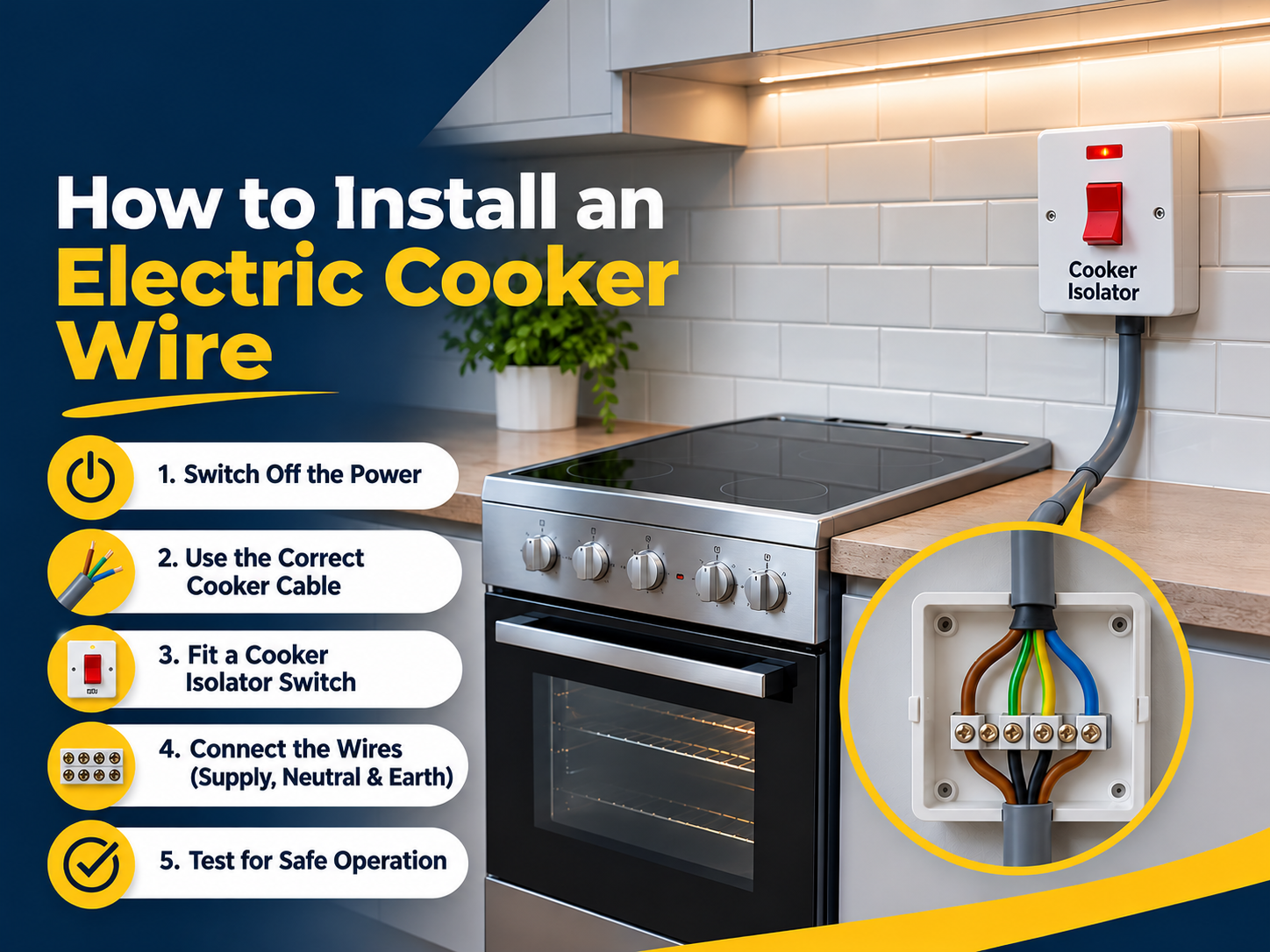
An electric cooker wire must match the cooker’s power needs and home circuit. A qualified electric cooker electrician checks the supply, fits the correct connection, and tests the full system before use.
This UK-focused guide from Local Electrical Solution explains how electric cooker wiring works, what equipment is needed, what safety checks matter, and how electricians can install modern cookers safely.
What Is Electric Cooker Wiring?
Electric cooker wiring is the process of connecting an electric cooker to a safe power supply.
An electric cooker uses a lot of electricity to heat food. It may need a separate electrical circuit. It also needs the correct cable, circuit protection, earthing and isolation.
Some small cookers come with a normal factory-fitted plug. Larger cookers often need a fixed electrical connection.
A wrong connection can cause:
Electric shock.
Overheating.
Damage to the cooker.
Short circuits.
Electrical fires.
For this reason, hardwired cooker installation must be done by a competent, qualified electrician.
Looking for an Electric Cooker Installer?
Need help with electric cooker wiring or installation? Send us your details and our team will get in touch.
Book Your Installation Enquiry
1. What Type of Connection Does Your Electric Cooker Need?
Before installing a cooker, an electrician must understand its power needs.
Different cookers need different electrical connections. The cooker manual and rating plate give important information.
| Cooker type | Type of connection | Important point |
|---|---|---|
| Small electric oven | May use a 13-amp plug | Check the maker’s instructions. |
| Single electric cooker | Plug or fixed connection | Depends on its power rating. |
| Double electric oven | Often fixed wiring | The supply must support the load. |
| Induction cooker | Often a dedicated circuit | Needs a suitable electrical supply. |
| Large range cooker | Usually a fixed connection | Needs careful circuit checks. |
Important: Never add a normal plug to a cooker that needs hardwiring. Do not use an extension lead to power a high-load cooker.
2. What Equipment Is Needed to Install an Electric Cooker Wire?
An electrician checks the cooker and the home’s electrical system before choosing the right materials.
The main parts are:
| Equipment | What it does |
|---|---|
| Cooker cable | Carries electricity to the cooker. |
| Cooker circuit | Supplies power to the appliance. |
| Circuit breaker | Helps protect the circuit from an electrical fault or overload. |
| Double-pole switch | Helps disconnect the cooker from the supply. |
| Earth wire | Provides a safe path for fault current. |
| Cooker connection unit | Provides the correct fixed connection point. |
| RCD or RCBO protection | Provides protection against certain electrical faults, where required. |
Each part has a different job.
The cable size must match the cooker and the circuit. An electrician must check the power rating, cable length, cable route and installation conditions.
There is no single cable size that is right for every electric cooker.
3. What Should an Electrician Check Before Installing a Cooker?
Checking the existing electrical system is an important part of cooker installation.
Local Electrical Solution advises homeowners to have the following points checked before any fixed wiring work begins.
| Safety check | Why it matters |
|---|---|
| Cooker power rating | Shows how much power the cooker may need. |
| Existing cable | Helps show whether the cable is suitable. |
| Consumer unit | Helps check the electrical protection. |
| Circuit breaker | Must be suitable for the circuit. |
| Earthing | Helps protect people during an electrical fault. |
| Cooker switch | Must be suitable for the appliance. |
| Cooker position | Must allow safe use and ventilation. |
Check the Cooker Manual
Every cooker model may have different needs.
The electrician should check:
The cooker model.
Its power rating.
The manufacturer’s installation guide.
The correct supply type.
The space needed around the cooker.
These details help the electrician plan the work.
Check the Existing Electrical Supply
An old cooker connection may not be suitable for a new cooker.
The electrician must check the condition of the existing circuit. They must also check the cable, protection and earthing.
A new cooker may need a new circuit or an electrical upgrade.
4. How Does a Qualified Electrician Install an Electric Cooker Safely?
The installation process depends on the cooker and the home’s electrical system.
Here are the main stages of professional installation.
| Stage | What the electrician does | Why it matters |
|---|---|---|
| 1. Inspection | Checks the cooker and power supply. | Finds possible problems. |
| 2. Circuit check | Checks cable and circuit protection. | Helps prevent overload. |
| 3. Safety isolation | Isolates the supply and proves it is dead. | Helps prevent electric shock. |
| 4. Cable selection | Selects the correct cable and connection system. | Supports safe operation. |
| 5. Connection | Connects the cooker according to its manual. | Provides the correct electrical supply. |
| 6. Final testing | Checks the circuit and cooker. | Confirms safe operation. |
Stage 1: Inspect the Cooker
First, the electrician checks the cooker model and its power rating.
They read the manufacturer’s instructions to understand the correct connection type.
They also check whether the existing cooker circuit can support the new appliance.
Stage 2: Check the Cable and Circuit
The electrician checks the cable, circuit breaker and cooker switch.
The cable must have the correct rating for the job.
A cable that is too small can become hot and may create a fire risk.
Stage 3: Isolate the Electrical Supply
Before any wiring work, the electrician must safely isolate the correct supply.
They must also use approved test equipment to prove that the circuit is dead.
Simply turning a switch off does not prove that a wire is safe to touch.
Stage 4: Connect the Cooker
The electrician makes the fixed electrical connection according to the cooker manual and the correct wiring rules.
The live, neutral and earth connections must be correctly identified and secured.
Old homes may have different wire colours from newer homes. Therefore, wire colours alone must never be used to decide which wire is safe or where it belongs.
Stage 5: Secure the Cooker
The cooker must sit properly in its place.
The electrician checks:
The cooker is level.
The cable is protected.
The cooker has enough ventilation.
The connection is not under pressure.
The cooker follows the maker’s fitting instructions.
Stage 6: Complete the Safety Tests
The electrician checks the full electrical installation.
They also check that the cooker works as expected.
Note: These are professional electrical tasks. Homeowners should not open the connection box or attempt fixed cooker wiring themselves.
5. What Safety Tests Are Needed After Cooker Installation?
Testing is just as important as connecting the cooker.
A cooker may look correctly installed but still have an electrical fault.
The electrician must complete the tests that apply to the installation.
| Test | What it checks |
|---|---|
| Visual inspection | Looks for damage and poor connections. |
| Continuity test | Checks electrical paths. |
| Insulation resistance test | Checks the condition of insulation. |
| Polarity test | Checks correct electrical connection. |
| Earth fault protection test | Checks the safety of the fault protection system. |
| RCD test | Checks the operation of the RCD, where fitted. |
| Functional test | Checks that the cooker works correctly. |
After the tests, the electrician should provide the correct electrical documents for the work.
These may include an Electrical Installation Certificate, a Minor Electrical Installation Works Certificate or a Building Regulations compliance certificate, as applicable.
6. What Mistakes Should You Avoid When Installing an Electric Cooker?
Small mistakes can create serious electrical problems.
Here are some common mistakes to avoid.
Using the wrong cable: Every cooker has its own power needs. A cable must be selected for the actual installation.
Using an unsuitable socket: A large cooker must not be connected to an ordinary socket unless its manufacturer specifically allows that connection.
Ignoring earthing: The earth connection is an important part of electrical safety.
Using the wrong circuit breaker: The protective device must match the cable and circuit design.
Skipping safety tests: A cooker should not be used until the required checks are complete.
Ignoring ventilation: A cooker needs enough space for safe heat movement.
Copying another installation: Two cookers may look the same but have different power needs.
7. What Should Homeowners Do Before the Electrician Arrives?
Homeowners can prepare for the installation without touching the electrical wiring.
Local Electrical Solution recommends these simple steps:
Keep the cooker area clear.
Find the cooker model and instruction manual.
Note the cooker power rating.
Make the existing cooker connection easy to access.
Tell the electrician about any old electrical problems.
Share pictures of the cooker and its rating label.
Ask about testing and certificates.
This can help the electrician understand the job before starting.
8. What Electrical Rules Apply to Cooker Wiring in the UK?
Electric cooker installation must follow the correct electrical safety rules.
In the UK, BS 7671 is the main standard for electrical installation work.
Part P of the Building Regulations covers electrical safety in homes in England and Wales.
A new cooker circuit is an example of work that needs Building Regulations notification. A registered competent-person electrician can usually handle the required notification and certification.
Rules can differ across the UK, so electricians must check the rules that apply in their area.
The main aim is to protect people from electric shock and fire.
9. How Can Future Electricians Install Electric Cooker Wiring?
The future of electrical installation is changing.
Modern homes are using more electric cooking equipment, smart appliances and home energy systems.
Future electricians will need more than basic wiring knowledge.
For future electricians, Local Electrical Solution highlights five important areas of learning.
| Future skill | Why electricians will need it |
|---|---|
| Load calculation | To understand the power needs of modern cookers. |
| Smart appliance knowledge | To understand connected ovens and smart controls. |
| Induction cooker knowledge | To understand modern electric cooking systems. |
| Home energy systems | To understand solar power, batteries and EV chargers. |
| Electrical testing | To check safety and correct operation. |
Understanding Smart Electric Cookers
Modern cookers may have smart features.
Some models can connect to mobile apps or home control systems.
Future electricians should understand how these appliances work and what electrical supply they need.
Learning About Induction Cookers
Induction cookers are becoming an important choice in modern kitchens.
They use electricity to heat cooking pans.
Electricians must understand their power ratings, connection needs and safety instructions.
Understanding Home Energy Systems
Some homes have solar panels, home batteries and electric vehicle chargers.
These systems can affect the home’s total electrical demand.
Future electricians should learn how to check the full electrical system before adding another high-power appliance.
Learning New Testing Methods
Electricians must keep learning about electrical testing equipment and current safety rules.
Good testing helps find faults before they cause serious problems.
The future electrician will need good practical skills, technical knowledge and clear communication.
10. Conclusion: Safe Electric Cooker Wiring Starts With the Right Checks
Installing an electric cooker wire is not just about connecting a cable. It requires the right circuit, suitable protection, correct earthing and proper safety tests.
A qualified electrician must check the appliance and the home’s electrical supply before making a fixed connection.
The main point from Local Electrical Solution is simple: correct planning, professional installation and proper testing help keep an electric cooker safe for everyday use.
Frequently Asked Questions About Electric Cooker Wiring
1. Can I install an electric cooker wire myself?
Not every electric cooker uses the same connection. Some small models come with a factory-fitted 13-amp plug. Many larger cookers need a separate cooker circuit and a fixed connection. Read the appliance manual and rating label first. When there is no factory plug, or the instructions say hardwire, ask a qualified electrician to check the supply. Ask an electrician first.
2. What size cable is needed for an electric cooker?
A cooker cable must suit the appliance’s power, the circuit design, and how the cable is installed. Cable length, heat, grouping with other cables, and the protective device also matter. There is no safe cable size for every cooker. A qualified electrician must calculate and confirm the correct cable before making any connection. Do not guess.
3. Can I connect an electric cooker to a normal socket?
Usually, no. A high-power cooker can draw more current than an ordinary socket circuit can safely supply. A wrong connection can cause overheating, electric shock, or fire. Only use a standard socket when the cooker came with a suitable factory-fitted plug and its manual permits it. Never fit a plug or use an extension lead yourself. Keep children away too.
4. What is a double-pole cooker switch?
A double-pole cooker switch is a control that can isolate both live and neutral conductors. It gives the electrician a clear way to disconnect the cooker for service or an emergency. Its rating, location, and connection must suit the appliance and the installation. The electrician should follow the cooker manual and current wiring rules for safety.
5. Do I need a new circuit for my electric cooker?
Not always. A cooker may use an existing circuit only if that circuit is suitable, safe, and meets the appliance instructions and current rules. The electrician checks the cable, protection, earthing, switch, and condition of the supply. A new cooker may need a new circuit or an upgrade. Do not assume the old one is suitable. Test it before use.
6. What does an electrician check before installing a cooker?
An electrician should check the cooker’s rating, manual, cable, protective device, cooker switch, earthing, and the condition of the consumer unit. They should also check space, ventilation, and safe cable routing. After the work, they complete the required electrical tests. Ask what certificate or building control record applies to the work. Keep these records safely before the cooker is used.
7. What are the signs of a cooker wiring problem?
Stop using the cooker if you smell burning, hear buzzing, see sparks, notice hot switches, or find scorch marks. Turn it off at the cooker switch only if it is safe to do so. Keep people away and contact a qualified electrician. If there is smoke or fire, leave the area and call emergency services. Do not touch exposed wires.
8. Does electric cooker installation need a safety certificate?
A new circuit may need building control approval or notification under Part P in England and Wales. A registered electrician can usually handle the required notification through their competent person scheme. Work on an existing circuit may have different notice rules. Ask the electrician before work begins and keep the certificate or compliance record. Check the current local rules first.
9. Does an induction cooker need special wiring?
Yes, an induction cooker may need a high-power supply, but the exact need depends on its model and rating. Some units allow a lower-power setting; others need a dedicated circuit. The electrician must read the manufacturer’s instructions and check the home supply. Never choose a cable or breaker by copying another cooker’s setup. Each model needs its own check first.
10. How can future electricians learn electric cooker installation?
Future electricians should learn load calculations, safe isolation, testing, earthing, and the current wiring rules. They should also understand induction cookers, smart controls, home batteries, solar power, and electric vehicle charging. These systems can share the home’s electrical capacity. Good training will help electricians plan safe circuits and explain choices clearly to customers. They must keep learning throughout their careers.