

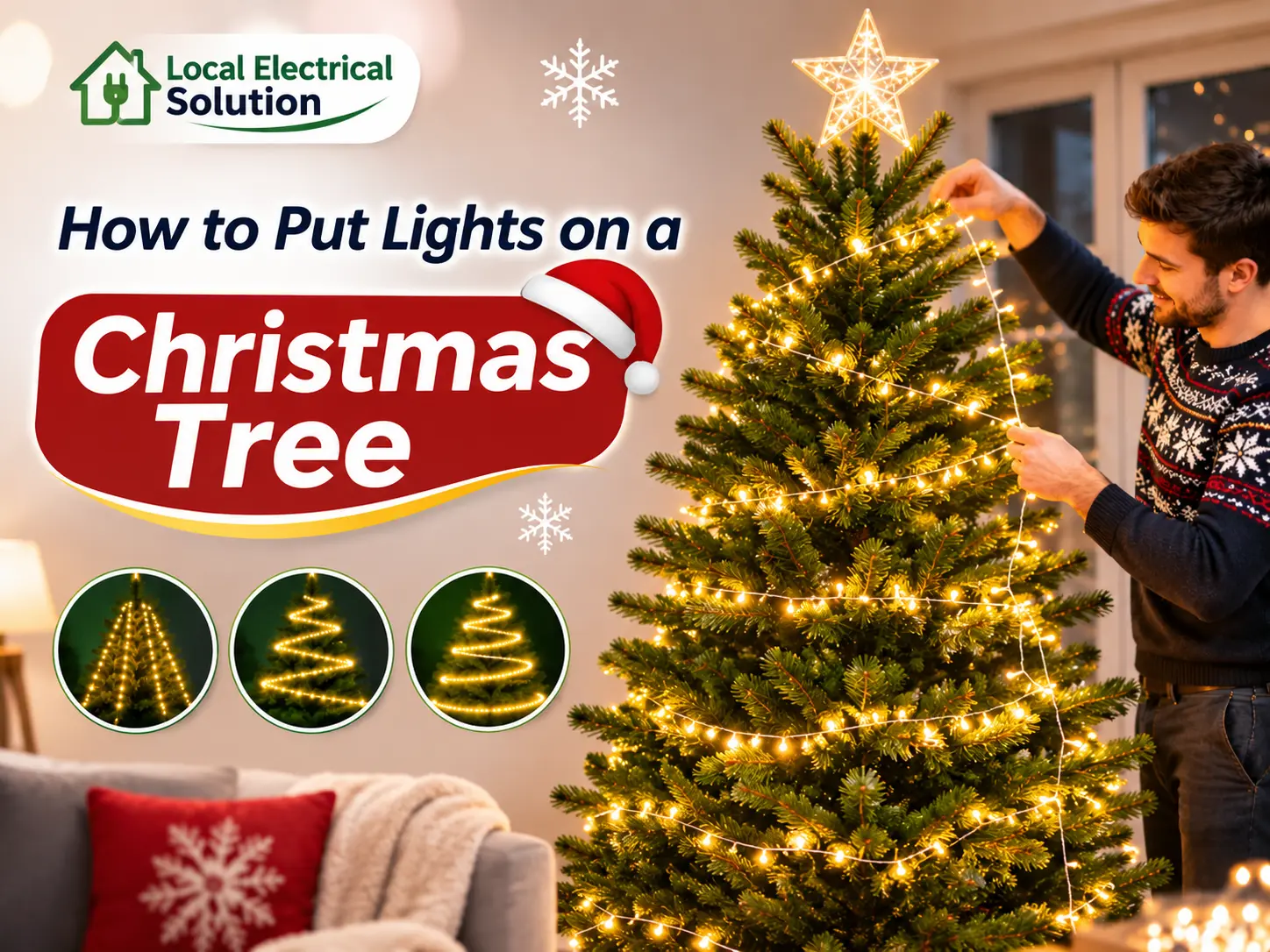
Putting lights on a Christmas tree is easy when you follow the right steps. Start by choosing good LED lights, checking that the wires are safe and testing every bulb. Begin at the bottom of the tree and work upwards. You can use a zigzag, vertical or spiral method to spread the lights evenly. Keep the wires neat and away from water. In this guide, we explain how to put lights on a Christmas tree in UK homes, with simple tips to create a bright, tidy and safe Christmas display.
How to Put Lights on a Christmas Tree UK: What You Need Before Starting
Before you start decorating your Christmas tree, take a few minutes to prepare. Good planning can save time and help you avoid common mistakes.
You do not need expensive tools to put lights on a Christmas tree. A few simple items are enough.
Here is what you should prepare:
LED Christmas tree lights.
A suitable extension lead, if needed.
Cable clips made for Christmas lights.
A soft cloth to clean the tree.
A stable step stool or ladder for taller trees.
A working electrical socket.
A small box to keep extra wires tidy.
Always check the instructions that come with your lights. Make sure the lights are suitable for indoor use if you are decorating a tree inside your home.
Christmas Lights Installation
Want a beautiful Christmas lighting display? Contact our electricians for help with your Christmas lighting needs.
Your local electrical installation support.
Things to Check Before Decorating
| Item | What to check | Why it matters |
|---|---|---|
| Christmas lights | Look for broken bulbs and damaged wires | Helps prevent electrical problems |
| Plug | Check for cracks or loose parts | Keeps the power connection safe |
| Socket | Look for burn marks or damage | Helps prevent overheating |
| LED bulbs | Check that the bulbs work | Gives an even light display |
| Tree position | Keep it near a suitable power source | Reduces trailing wires |
A good rule is to test your lights before putting them on the tree. This helps you find problems early.
How to Put Lights on a Christmas Tree for Beginners
If this is your first time decorating a Christmas tree, do not worry. You can get a beautiful result by following a simple method.
Follow these easy steps:
Step 1: Choose the right place for your tree
Place your tree in a spot where people can enjoy it from different angles. Keep it away from heaters, fireplaces and busy walking areas.
Also, check where the nearest socket is. This will help you avoid long wires across the room.
Step 2: Open the branches
If you have an artificial tree, spread the branches before adding lights. Make sure there are no large empty spaces.
For a real tree, check that the branches are strong enough to hold the lights.
Step 3: Test your lights
Connect the lights as instructed by the manufacturer. Check that all bulbs work and that there are no damaged cables.
Step 4: Start at the bottom
Leave enough cable to reach the power source without pulling or stretching it.
Begin near the bottom of the tree and slowly move upwards.
Step 5: Spread the lights evenly
Move the lights around the branches. Try to place some lights deeper inside the tree and others near the front.
Step 6: Check the final look
Switch on the lights and look at the tree from different sides. Move any lights that are too close together or leave dark spaces.
You can now add baubles, ribbons and other decorations.
How to Put Lights on a Christmas Tree Top to Bottom
Many people ask whether they should start at the top or bottom of a Christmas tree.
For most standard plug-in light sets, starting at the bottom is a simple option. It allows you to check the cable length and work towards the top.
However, you can also use a top-to-bottom method if the light set and power connection allow it.
Here is how to do it:
Place the tree in its final position.
Check the full length of the light string.
Start near the top of the tree.
Slowly move down from one branch to another.
Keep enough space between each row of lights.
Check the display before adding decorations.
Important: Do not pull the wires tightly or stretch them between branches. Always follow the light manufacturer’s connection instructions.
If your plug is at the bottom, plan the cable route before starting. Do not leave the plug hanging or place it where it can be pulled.
How to Put Lights on a Christmas Tree Zig Zag
The zigzag method is one of the easiest ways to decorate a Christmas tree.
Instead of wrapping the lights around the whole tree, you move them from one side to the other.
This method works well when your tree is placed against a wall.
Steps to Use the Zigzag Method
Start at the bottom of the tree.
Move the lights towards the left side.
Bring the wire across to the right side.
Move it back towards the left.
Repeat this pattern as you move upwards.
Keep the gaps between the lights even.
Check the front of the tree for dark spaces.
Try to place some lights inside the branches. This gives the tree a deeper and brighter look.
Zigzag Lighting Pattern
| Step | Light direction | What to do |
|---|---|---|
| 1 | Bottom left | Start near the base |
| 2 | Bottom right | Move across the branches |
| 3 | Middle left | Continue the zigzag |
| 4 | Middle right | Keep the same spacing |
| 5 | Top | Finish near the top branch |
Helpful tip: Do not pull the wire tightly around the branches. Leave enough space so you can remove the lights easily after Christmas.
How to Put Lights on a Christmas Tree Vertically
The vertical method is another great way to decorate your Christmas tree.
Instead of moving around the tree in circles, you place the lights in vertical lines from the bottom towards the top.
This method can make it easier to remove the lights after Christmas.
Follow These Steps
Step 1: Start at the bottom of the tree.
Step 2: Move the lights upwards along one section of the tree.
Step 3: When you reach the top, bring the wire back down through another branch.
Step 4: Move to the next section and repeat the process.
Step 5: Continue until the visible parts of the tree have an even light display.
Step 6: Step back and check the whole tree.
The vertical method works well for both real and artificial trees. It is also useful if you want to decorate the tree in separate sections.
Do not leave long wires hanging between branches. Keep them neat and secure without damaging the cable.
How to Put Lights on a Christmas Tree Hack: Simple Tricks for a Better Display
You do not need to be an expert to make your Christmas tree look beautiful. A few simple tricks can make a big difference.
Here are some useful Christmas tree lighting hacks.
1. Start with the Inner Branches
Do not place every light on the outside of the tree.
Move some lights closer to the trunk. This creates a soft glow from the inside and makes the tree look fuller.
2. Use One Colour Theme
Choose warm white, cool white or colourful LED lights.
Using one main colour can make your tree look neat and well planned.
3. Divide the Tree into Sections
Think of your tree as three parts:
Bottom section.
Middle section.
Top section.
Decorate each part before moving to the next one. This makes it easier to spread the lights evenly.
4. Check the Tree from a Distance
Do not only look at the tree from close up.
Stand across the room and check whether the lights are evenly spread.
5. Keep Extra Wire Neat
Do not hide extra cable by wrapping it tightly around the branches. Follow the manufacturer’s instructions and keep the wire away from sharp edges.
6. Use a Timer or Smart Plug
A suitable timer can switch your Christmas lights on and off at set times.
This is useful if you do not want to remember to switch them off every night. Make sure the timer and plug are suitable for your lighting set.
How Many Lights Do You Need for a Christmas Tree?
The number of lights depends on the height, width and shape of your tree.
A small tree needs fewer lights than a large tree. A thick tree may also need more lights than a narrow tree of the same height.
The table below gives a simple starting guide. These are planning estimates, not fixed rules.
| Christmas tree height | Suggested number of LED lights | Display |
|---|---|---|
| 4ft tree | 200–300 | Soft glow |
| 5ft tree | 300–400 | Balanced display |
| 6ft tree | 400–600 | Bright display |
| 7ft tree | 500–700 | Full display |
| 8ft tree | 600–800 | Rich display |
| 9ft tree | 700–1,000 | Large display |
Always check the manufacturer’s recommendations before buying your lights. Different light sets have different bulb spacing and brightness.
How to Choose the Right Christmas Tree Lights
| Light type | Best for | Main benefit |
|---|---|---|
| Warm white LED | Traditional Christmas trees | Soft and cosy look |
| Cool white LED | Modern Christmas trees | Bright and clean look |
| Multicolour LED | Family Christmas displays | Fun and colourful effect |
| Battery-powered lights | Small trees and areas without nearby sockets | No mains cable running to the tree |
| Smart LED lights | Modern homes | App and timer controls |
For most homes, LED Christmas lights are a good choice. They use less electricity than older filament lights and usually produce less heat.
Which Is the Best Way to Put Lights on a Christmas Tree?
There are different ways to decorate a Christmas tree. The best method depends on its size, shape and location.
Some people prefer the zigzag method because it is quick. Others prefer the vertical method because it makes removing the lights easier.
| Lighting method | How it works | Best for |
|---|---|---|
| Zigzag method | Lights move from left to right | Trees placed against a wall |
| Vertical method | Lights move up and down | Easy removal after Christmas |
| Spiral method | Lights go around the tree | Trees visible from all sides |
| Branch weaving | Lights move inside and outside the branches | A fuller, deeper glow |
Our Recommendation
If you are decorating your tree for the first time, start with the zigzag method.
If your tree is in the centre of your living room, the spiral or branch-weaving method can give a more even display from different angles.
If you want to remove the lights quickly after Christmas, try the vertical method.
Christmas Tree Electrical Safety Tips for UK Homes
A beautiful Christmas tree should also be a safe Christmas tree.
As electricians, we believe that checking your lights and electrical connections is just as important as making your tree look good.
Electrical Safety First advises people to check Christmas lights for damage, use the correct lights for indoor and outdoor areas, avoid overloaded sockets and switch lights off before going to bed or leaving home.
Here are some important safety tips for UK homeowners.
1. Always Check Your Christmas Lights
Before using old Christmas lights, check the wires, bulbs, plug and transformer.
Look for:
Frayed or damaged cables.
Loose wires.
Broken bulbs.
Cracked plugs.
Signs of overheating.
If you find damage, stop using the lights. Do not try to repair faulty Christmas lights yourself.
2. Choose LED Christmas Lights
LED lights are a good choice because they use less electricity and produce less heat than traditional filament lights.
Extra-low-voltage LED sets are also a good option. Electrical Safety First explains that extra-low-voltage Christmas lights commonly operate at around 12–24 volts.
3. Do Not Overload Your Sockets
Do not plug too many Christmas decorations into one socket.
Avoid joining extension leads together or using too many adaptors.
Use suitable electrical equipment and follow its instructions.
4. Check RCD Protection
An RCD is a safety device that can switch off electricity when it detects a fault.
It helps protect people from electric shock.
Electrical Safety First recommends RCD protection for outdoor electrical equipment. If you are unsure whether your sockets have suitable protection, ask a qualified electrician to check.
5. Use the Right Lights for Indoor and Outdoor Areas
Never use indoor Christmas lights outside.
Outdoor lights should have a suitable IP rating for the conditions where they will be used.
An IP rating tells you how well electrical equipment is protected against dust and water. Always check the product instructions before installation.
6. Switch Off Your Lights Before Sleeping
Do not leave Christmas tree lights switched on overnight or when nobody is at home.
Switch them off at the socket when they are not needed.
7. Keep Lights Away from Water and Heat
If you have a real Christmas tree, keep it watered according to its care instructions.
Keep plugs, transformers and electrical connections away from water.
Also, keep Christmas lights away from candles, heaters, fireplaces and materials that can catch fire.
Need help with electrical safety? Local Electrical Solution can help homeowners understand their electrical safety needs and find suitable electrical support for their homes.
Common Christmas Tree Lighting Mistakes to Avoid
Many people make small mistakes when putting lights on a Christmas tree. These mistakes can affect the final look and may also create safety problems.
| Common mistake | Why it is a problem | Better solution |
|---|---|---|
| Not testing lights first | You may find faulty bulbs later | Test before decorating |
| Putting all lights outside | The tree may look flat | Place some lights deeper inside |
| Using too few lights | Large dark spaces may appear | Plan the number of lights |
| Pulling wires too tightly | Wires may become damaged | Leave enough space |
| Using indoor lights outside | The lights may not resist water | Choose outdoor-rated lights |
| Overloading sockets | Can cause overheating | Use suitable power connections |
| Leaving lights on overnight | Creates an avoidable electrical risk | Switch them off before sleeping |
Taking a few minutes to avoid these mistakes can help you create a better Christmas display.
The Future of Christmas Tree Lighting: How UK Homes May Decorate Their Trees
Christmas tree lighting is changing as new technology becomes available. In the future, UK homeowners may use more smart lights, automatic controls and energy-saving lighting systems.
Here are some ways Christmas tree lighting may change in the coming years.
1. Smart Christmas Tree Lights
Smart lights allow people to control brightness and colour through a mobile phone or voice assistant.
In the future, more Christmas lights may connect with home automation systems. People may be able to change the tree’s appearance without touching the lights.
2. Lights That Change with Music
Music-controlled Christmas lights are already available.
Future systems may offer better control over colours, brightness and lighting patterns. The lights may respond to music played in the room.
3. Automatic Lighting Schedules
Smart plugs and lighting controls can help people set automatic on and off times.
Future systems may use more advanced schedules based on daily routines, daylight and energy-saving settings.
4. More Energy-Efficient LED Technology
LED technology is likely to remain an important part of Christmas lighting.
Future products may offer brighter displays while using less electricity. Longer-lasting and more repair-friendly designs may also become more common.
5. Wireless and Battery-Powered Designs
More battery-powered and rechargeable Christmas lights may become available.
These products can help people decorate places where a power socket is not nearby.
However, battery-powered lights still need safe handling. Keep button batteries away from children and follow the product instructions.
The important thing to remember: Smart technology does not remove the need for electrical safety. Homeowners should still use suitable products, check cables and follow the manufacturer’s instructions.
A Christmas Tree Lighting Idea Most Guides Miss: Plan the Lights Around Your Room
Most Christmas tree guides explain how to wrap lights around branches. But there is another important part that people often forget.
You should plan your Christmas tree lighting around the room before you start decorating.
This simple step can make the display look better and help prevent cable problems.
Step 1: Look at Your Room
Check where people sit and where they normally walk.
Choose a tree position where it can be seen clearly without blocking doors or walkways.
Step 2: Check the Power Socket
Find the nearest suitable socket before placing your tree.
Try to avoid running long cables across the floor.
Step 3: Think About the Viewing Angle
If your tree is against a wall, you may not need to decorate the back with the same amount of lighting.
If your tree is in the middle of the room, plan to light all sides.
Step 4: Plan the Cable Route
Keep wires away from areas where people walk.
Do not trap cables under rugs, doors or heavy furniture.
Step 5: Plan for Future Decorations
Think about whether you may want to add more lights, a smart plug or other decorations in the future.
Do not add extra light sets unless the manufacturer confirms that the products can be connected safely.
This room-first approach helps you create a neat display while keeping your home practical and safe.
When Should You Contact a Professional Electrician?
You can put ordinary plug-in Christmas lights on your tree yourself by following the manufacturer’s instructions.
However, some electrical problems need professional help.
Contact a qualified electrician if:
Your socket becomes hot when Christmas lights are connected.
You notice burning smells or marks near a socket.
Your circuit breaker or RCD keeps tripping.
You need a new socket near your Christmas tree.
You want permanent outdoor lighting installed.
You are unsure whether your outdoor electrical connections are safe.
Never try to open a socket or repair fixed electrical wiring yourself.
Local Electrical Solution understands the importance of safe electrical systems in UK homes. If you need help with electrical installations or electrical faults, contact a qualified professional.
Final Thoughts
Putting lights on a Christmas tree does not have to be difficult. Choose the right LED lights, test them before use and pick a lighting method that suits your tree.
The zigzag, vertical and spiral methods can all create a beautiful display. The most important thing is to spread the lights evenly and keep the cables safe.
Remember to check your sockets, avoid overloading extension leads and switch off your lights before sleeping or leaving home.
With a little planning, you can enjoy a bright, beautiful and safe Christmas tree throughout the festive season.
Frequently Asked Questions About How to Put Lights on a Christmas Tree
1. Should you put Christmas tree lights on from top to bottom or bottom to top?
For most people, starting at the bottom is the easiest method. It helps you check that the power cable reaches the socket before decorating. You can then move upwards while spreading the lights across the branches. However, the top-to-bottom method can also work if your light set allows it. Always follow the manufacturer’s instructions.
2. What is the best way to put lights on a Christmas tree?
The best method depends on where your tree is placed. The zigzag method is useful for trees against a wall, while the spiral method works well for trees visible from all sides. The vertical method can make removing lights easier. Whichever method you choose, spread the lights evenly and place some deeper inside the branches.
3. How many lights do I need for a 6ft Christmas tree?
A 6ft Christmas tree may need around 400–600 LED lights for a bright display. However, the number depends on the width of the tree, the spacing between bulbs and how bright you want it to look. A narrow tree may need fewer lights. Always check the manufacturer’s recommendations before buying a new set.
4. Can you put Christmas lights on a tree vertically?
Yes, you can put Christmas lights on a tree vertically. Start near the bottom and move the lights towards the top along one section. Then bring the wire down through another section. Repeat this process around the tree. Keep the wires neat and avoid pulling them tightly. This method can also make removing lights easier after Christmas.
5. Is it better to put lights on a Christmas tree before decorations?
Yes, it is usually better to put lights on your Christmas tree before adding baubles, ribbons and other decorations. This gives you more room to move the wires around the branches. It also helps you spread the lights evenly without knocking off decorations. Once the lights are in place, you can add your favourite Christmas ornaments.
6. Are LED Christmas tree lights safer than traditional lights?
LED Christmas lights are generally a better choice because they use less electricity and produce less heat than traditional filament lights. Extra-low-voltage LED lights can also reduce the risk of electric shock. However, no lighting product is completely risk-free. Always check the wires, use suitable lights and follow the manufacturer’s safety instructions.
7. Can I leave my Christmas tree lights on overnight?
No, it is best to switch off and unplug Christmas tree lights before going to sleep or leaving your home. This helps reduce avoidable electrical and fire risks. You can use a suitable timer to control when the lights switch on and off. Always check that the timer is compatible with your lighting set.
8. Can I use indoor Christmas lights outside?
No, indoor Christmas lights should not be used outside. They may not have enough protection against rain, moisture and other outdoor conditions. Choose lights that are clearly marked as suitable for outdoor use. Check their IP rating and follow the manufacturer’s instructions. Outdoor electrical connections should also have suitable RCD protection.
9. How do I stop Christmas tree lights from getting tangled?
The easiest way to prevent tangled lights is to keep the wires organised before and after decorating. Test each set first and open the wire carefully. Do not pull or twist the cables tightly around branches. After Christmas, remove the lights gently and store them in a dry box or cable organiser.
10. What will Christmas tree lighting look like in the future?
Future Christmas tree lighting may include more smart LED lights, automatic controls, music-based effects and rechargeable lighting sets. Homeowners may be able to control colours and brightness using mobile phones or voice assistants. These features can make decorating easier. However, safe electrical products and correct installation will remain important for every home.














One Response