What is a SWA Cable? SWA stands for Steel Wire Armoured cable. It is a strong electrical cable designed to carry electricity while providing extra protection against physical damage. It has a layer of steel wires around the insulated electrical cores, making it suitable for demanding installations.
SWA cable is commonly used in the UK for underground supplies, outdoor electrical work, garages, garden rooms, workshops and commercial buildings. It is available in different sizes and core configurations to suit different electrical requirements.
The correct SWA cable size depends on factors such as load, cable length, installation method, voltage drop and earthing requirements. It should be installed by a competent electrician.
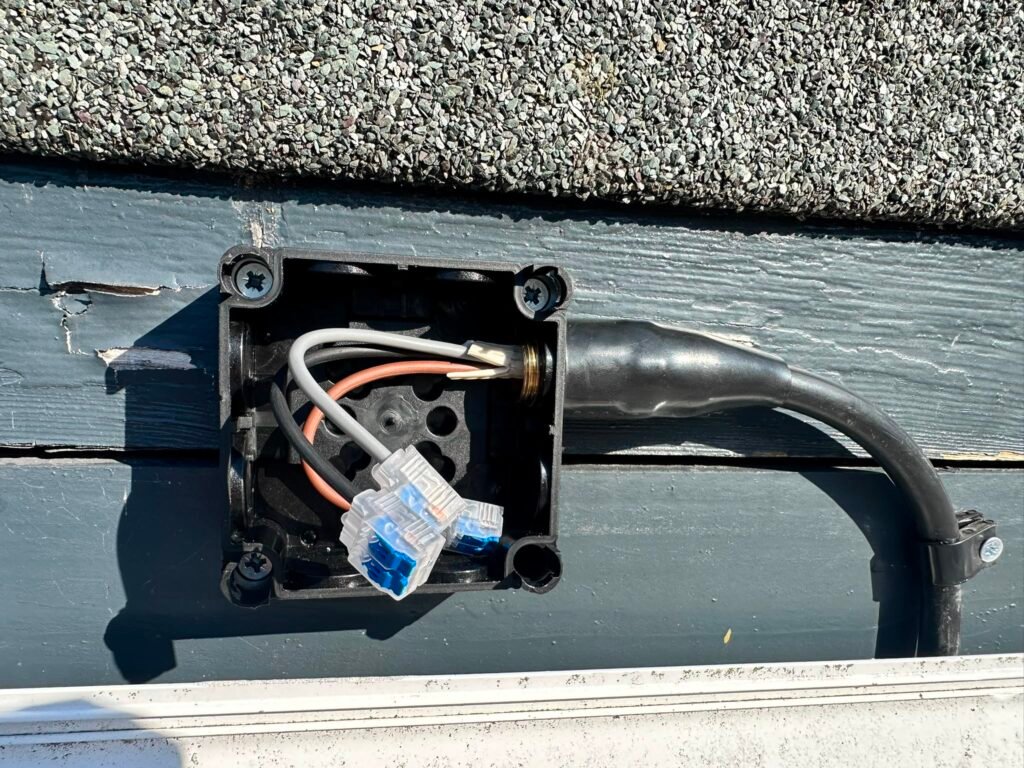
What Does SWA Cable Mean?
SWA means Steel Wire Armoured.
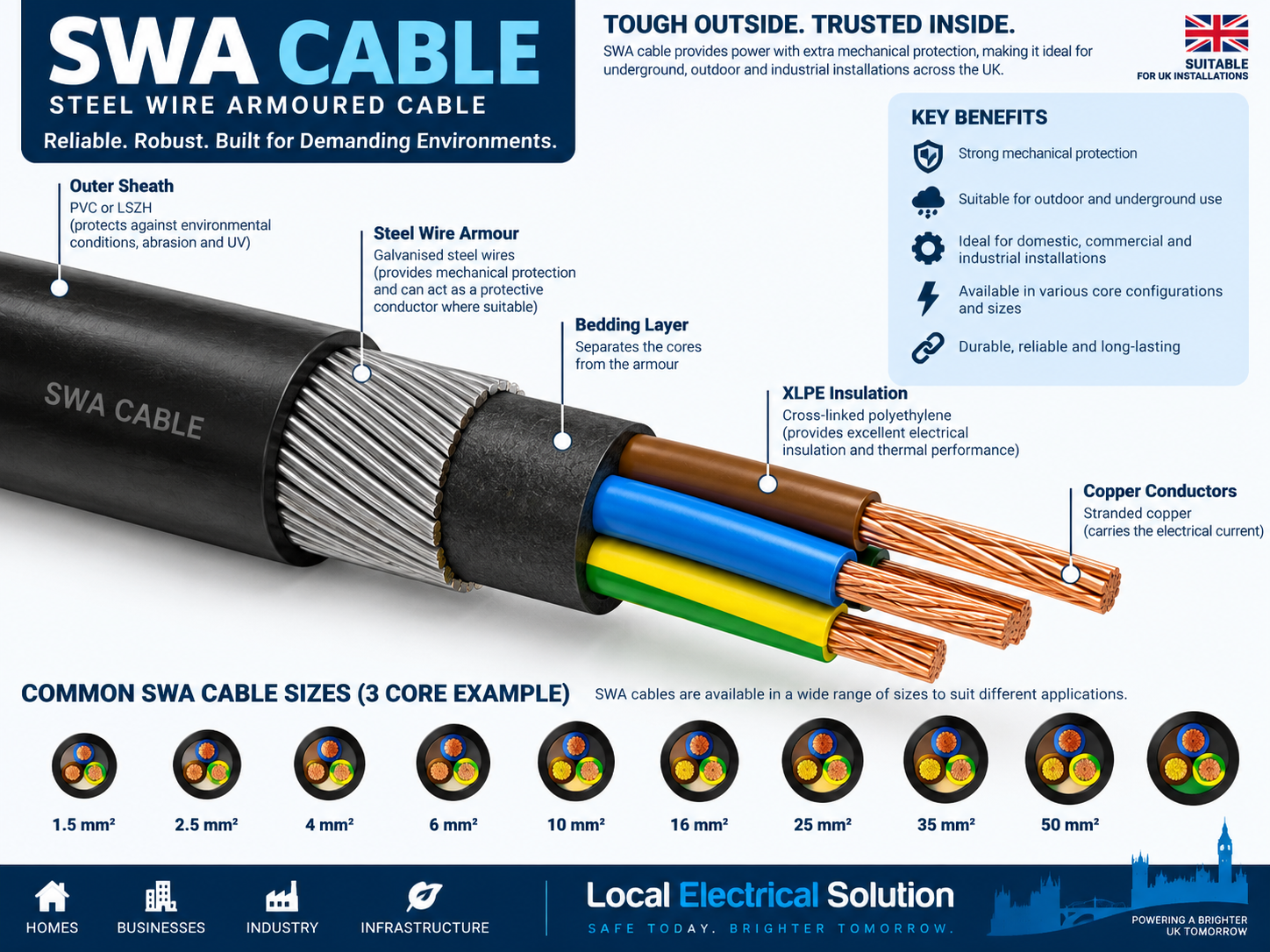
The name describes the construction of the cable. Steel wires are positioned around the cable’s inner layers to provide additional mechanical protection. Modern low-voltage SWA designs commonly use stranded copper or aluminium conductors, XLPE insulation, bedding, steel wire armour and an outer sheath.
A typical 600/1000 V SWA construction can therefore be understood as:
| Cable layer | Main purpose |
|---|---|
| Copper or aluminium conductor | Carries electrical current |
| XLPE insulation | Electrically separates the conductors |
| Bedding/inner sheath | Provides a suitable layer beneath the armour |
| Steel wire armour | Mechanical protection and, where suitable, protective conductor function |
| Outer sheath | Protection from environmental conditions and abrasion |
Cleveland Cable describes modern BS 5467 armoured cable as incorporating XLPE insulation, PVC sheathing and galvanised steel wire armour, with typical applications including underground, outdoor, industrial and commercial installations.
Why Is SWA Cable Used?
The primary reason for using SWA is mechanical protection.
An ordinary cable installed in a vulnerable outdoor or underground location could be exposed to accidental impact, crushing, abrasion or other mechanical stresses. The steel armour provides an additional protective barrier.
SWA is particularly useful where a cable needs to travel:
- Underground
- From a house to a garage
- From a property to a garden room
- To an external workshop
- Along an external wall
- Through an industrial environment
- Between distribution boards
- To external equipment
- Through cable ducts
- Across commercial or agricultural sites
The armour also gives SWA cable considerable mechanical strength. However, it does not mean that every SWA installation can automatically be installed without considering additional protection. The installation method and surrounding conditions still need to be assessed.
Where Is SWA Cable Commonly Used in the UK?
SWA cable has a wide range of applications.
For domestic properties, common examples include supplying:
- Detached garages
- Garden rooms
- Workshops
- Sheds
- Outdoor sockets
- Garden lighting
- Outbuildings
- Hot tubs
- External equipment
- Sub-main distribution boards
In commercial and industrial settings, SWA is frequently used for power distribution, machinery supplies, control applications and external installations. UK suppliers also list applications including construction sites, renewable-energy projects, infrastructure, power networks and industrial environments.
Local Electrical Solution can assess whether SWA is appropriate for an external supply, rather than assuming that armoured cable is automatically required for every outdoor circuit.
What Is Inside an SWA Cable?
A typical modern SWA cable contains several layers, each serving a specific purpose.
1. Conductors
The conductors carry the electrical current. Copper is widely used because of its excellent electrical conductivity, although aluminium conductors are also available in some cable designs.
2. XLPE Insulation
XLPE means cross-linked polyethylene. It provides electrical insulation around the conductors and offers good thermal performance.
The IET explains that SWA cables covered by BS 7671 Appendix 4 include thermoplastic and thermosetting constructions, with modern SWA commonly manufactured with XLPE insulation to standards such as BS 5467 and BS 6724.
3. Bedding
The bedding separates the insulated cores from the armour and provides a suitable protective layer.
4. Steel Wire Armour
This is the defining feature of SWA cable. The steel wire armour provides mechanical protection and can, in suitable designs, contribute to the protective conductor arrangement.
5. Outer Sheath
The outer sheath protects the cable against environmental influences, abrasion and other external conditions.
What Are the Different Types of SWA Cable?
SWA is available in different core configurations, conductor sizes and sheath constructions.
| Type | Typical arrangement/use |
|---|---|
| 2-core SWA | Two conductors; suitable applications depend on the circuit design and earthing arrangement |
| 3-core SWA | Common for single-phase supplies and other applications requiring three conductors |
| 4-core SWA | Commonly used for three-phase supplies where a neutral arrangement is required |
| 5-core SWA | Often used for three-phase systems requiring separate neutral and protective conductor arrangements |
| Multi-core control SWA | Used for control and signalling applications |
The actual purpose of each cable depends on the circuit design. A three-core cable should not simply be described as “live, neutral and earth” in every installation because conductor identification and the way the armour or separate protective conductor is used can vary.
For example, suppliers list three-core SWA with both traditional brown/black/grey identification and versions using brown, blue and green/yellow identification.
2-Core vs 3-Core SWA Cable
One of the most common questions is whether to use 2-core or 3-core SWA.
A 2-core cable provides two insulated conductors. A 3-core cable provides three insulated conductors. The correct choice depends on the electrical design, earthing arrangement and equipment being supplied.
For a typical domestic single-phase supply to an outbuilding, a 3-core SWA may provide greater flexibility, but that does not mean it is automatically the correct cable.
The installer should establish:
- Supply type
- Load current
- Earthing arrangement
- Protective conductor requirements
- Cable route
- Voltage drop
- Fault-current conditions
- Installation method
- Termination requirements
What Size SWA Cable Do I Need?
There is no universal answer to “What size SWA cable do I need?”
Cable size should be calculated rather than guessed.
The selection can depend on:
- Design current
- Protective-device rating
- Installation method
- Ambient temperature
- Grouping with other cables
- Thermal insulation
- Cable length
- Voltage drop
- Earth fault loop impedance
- Short-circuit conditions
- Conductor material
- Number of loaded cores
- Earthing arrangement
For example, a 6 mm² cable might be suitable for one installation but unsuitable for another because the second circuit has a longer cable run, different installation method or greater voltage-drop requirement.
A supplier may list 3-core SWA sizes from 1.5 mm² upwards, while larger commercial ranges can extend into hundreds of square millimetres.
Example SWA Selection Considerations
| Factor | Why it matters |
|---|---|
| Load | Determines required current-carrying capacity |
| Length | Longer runs can increase voltage drop |
| Installation method | Changes cable current capacity |
| Grouping | Nearby cables can reduce allowable capacity |
| Temperature | Heat affects cable performance |
| Protective device | Must coordinate with the cable |
| CPC/earthing | Must provide adequate fault protection |
| Environment | Moisture, UV and mechanical conditions matter |
For this reason, Local Electrical Solution recommends that cable sizing is determined as part of the electrical design rather than selected solely from an online cable-size chart.
Can SWA Cable Be Buried Underground?
Yes, SWA cable is widely used for underground electrical installations, but the installation must still satisfy the applicable requirements.
A common example is a cable running from a house to a detached garage or garden building.
The designer or electrician should consider:
- Cable depth
- Route
- Mechanical protection
- Warning/protection measures
- Ground conditions
- Cable type
- Voltage drop
- Cable rating
- Future excavation risk
- Entry and exit points
- Termination arrangements
SWA’s armour provides substantial mechanical protection, but saying that it can simply be buried anywhere without considering the installation conditions is misleading.
BS 7671 contains requirements concerning cables installed underground, and the actual installation should be designed accordingly.
Can SWA Cable Be Used Outdoors?
Yes. SWA is commonly used outdoors because its construction is designed to provide substantial mechanical and environmental protection.
Typical outdoor applications include:
- Garden rooms
- Garages
- Workshops
- External lighting supplies
- Garden power
- Outbuilding supplies
- Commercial external power
- Renewable-energy installations
However, the outer sheath does not eliminate the need for correct installation. Cable supports, cleats, glands, bends, entry points and protection from potential damage all need consideration.
Is SWA Cable Waterproof?
It is more resistant to environmental conditions than many ordinary cables, but “waterproof” is an oversimplification.
The cable’s construction can provide resistance to moisture and outdoor conditions, but the termination points are particularly important. Water can enter through an incorrectly selected or installed gland, enclosure or connection.
Therefore, the cable and its complete termination system should be treated as one installation.
What Are SWA Cable Glands?
SWA cable glands are specialised cable-entry fittings designed for armoured cable.
A correct gland can provide:
- Mechanical retention
- Strain relief
- Armour termination
- Earthing/bonding connection where required
- Protection at the cable entry
- Compatibility with the enclosure
- Appropriate ingress protection
The correct gland depends on the cable construction, cable diameter, armour characteristics, enclosure and installation environment. Cleveland Cable specifically notes that the gland needs to secure the sheath, bond the armour where required and provide mechanical retention.
SWA glands should not be treated like ordinary PVC cable glands.
Does the Armour of SWA Cable Need to Be Earthed?
The answer depends on the design of the installation and how the armour is being used.
The armour may be used as a circuit protective conductor (CPC) if it satisfies the applicable requirements. It must not simply be assumed to be adequate because the cable has steel armour.
The IET states that when SWA armour is used as a CPC, its copper-equivalent cross-sectional area needs to be calculated, with BS 7671 Table 54.7 providing relevant guidance and Table 54.4 providing values associated with the armour when used as a protective conductor.
This is an important area where DIY assumptions can create serious safety problems.
SWA Cable and BS 7671
Electrical installations in the UK should be designed and installed in accordance with the requirements applicable to the installation, including BS 7671 where relevant.
BS 7671 covers subjects that directly affect SWA installations, including:
- Protection against electric shock
- Protection against overcurrent
- Selection and erection of wiring systems
- Current-carrying capacity
- Voltage drop
- Earthing and protective conductors
- External influences
- Underground wiring systems
- Inspection and testing
The IET’s own guidance confirms that SWA armour can be used as a CPC only where the relevant requirements are satisfied.
What Are BS 5467 and BS 6724?
BS 5467 and BS 6724 are important standards associated with thermosetting-insulated armoured cables.
Broadly:
| Standard | General relevance |
|---|---|
| BS 5467 | Thermosetting-insulated armoured cables, commonly PVC-sheathed SWA |
| BS 6724 | Armoured cables with reduced smoke/corrosive gas characteristics, commonly LSZH/LS0H designs |
Quickbit identifies BS 5467 and BS 6724 as standards covering construction and testing of relevant thermosetting-insulated armoured cables.
Always check the manufacturer’s data sheet for the exact cable specification rather than assuming that every cable described commercially as “SWA” has identical properties.
PVC SWA vs LSZH SWA
The choice between PVC and LSZH can be important where fire-performance requirements apply.
| Feature | PVC SWA | LSZH SWA |
|---|---|---|
| Outer material | PVC | Low-smoke zero-halogen compound |
| Typical use | General installations | Locations where reduced smoke/corrosive emissions are important |
| Cost | Often economical | Usually higher |
| Fire behaviour | Depends on product | Designed for reduced smoke/halogen emissions |
| Common standard | BS 5467 | BS 6724 |
Electrical4Less also identifies PVC SWA as a cost-effective option and LSZH SWA as appropriate where enhanced fire protection considerations apply.
SWA vs AWA: What Is the Difference?
SWA means Steel Wire Armour, while AWA means Aluminium Wire Armour.
The distinction becomes particularly important with single-core cables.
Steel armour is generally used with multicore cables, whereas aluminium armour is commonly used with single-core armoured cables because the magnetic effects associated with steel armour around a single conductor can cause unwanted heating.
YESSS Electrical and Quickbit both identify AWA as the common armour solution for single-core applications.
Advantages of SWA Cable
The main advantages include:
- Strong mechanical protection
- Suitable for many outdoor installations
- Suitable for many underground applications
- Available in numerous conductor sizes
- Available with different core configurations
- Can be used in domestic, commercial and industrial systems
- Good resistance to impact and crushing
- Suitable for cable ducts
- Can provide a protective conductor function where properly designed
- Available in PVC and LSZH constructions
Disadvantages of SWA Cable
SWA is not perfect for every application.
Potential disadvantages include:
- Heavier than ordinary cable
- More difficult to bend
- More difficult to strip and terminate
- Requires suitable glands and accessories
- Can be more expensive
- Requires careful cable sizing
- Incorrect gland installation can compromise safety
- The armour cannot automatically be assumed to be an adequate CPC
Because SWA is relatively stiff and heavy, cable routing and support should be planned before installation.
How Is SWA Cable Terminated?
SWA cable is normally terminated using a suitable armoured cable gland.
The process involves preparing the cable, exposing the armour correctly, fitting the gland components and securing the cable while maintaining the required protective and environmental characteristics.
This is not simply a case of inserting the cable into a hole and tightening a nut.
The termination must be compatible with:
- Cable size
- Cable construction
- Armour type
- Equipment
- Enclosure
- IP requirements
- Earthing arrangement
- Manufacturer’s instructions
Cleveland Cable advises that SWA termination should be carried out by competent persons in accordance with BS 7671 and the manufacturer’s guidance.
Common SWA Cable Installation Mistakes
Some common mistakes include:
- Selecting cable size based only on the MCB rating.
- Ignoring voltage drop on long runs.
- Assuming the armour is automatically a sufficient CPC.
- Using the wrong gland.
- Failing to bond the armour correctly where required.
- Excessively bending the cable.
- Ignoring installation temperature and grouping.
- Treating all SWA cables as having identical specifications.
- Assuming “armoured” means no additional protection is ever required.
- Failing to test and certify the completed installation.
These issues are particularly important on long runs to garages, garden rooms, workshops and commercial outbuildings.
How Do You Choose the Right SWA Cable?
Use this practical checklist:
Step 1: Establish the supply voltage and phase arrangement.
Step 2: Calculate the design current.
Step 3: Determine the cable length.
Step 4: Establish the installation method.
Step 5: Calculate current-carrying capacity.
Step 6: Check voltage drop.
Step 7: Check fault protection and CPC requirements.
Step 8: Consider environmental and mechanical conditions.
Step 9: Select the correct number of cores.
Step 10: Select suitable glands, cleats and accessories.
Step 11: Install and terminate the cable correctly.
Step 12: Inspect, test and certify the completed installation where required.
This approach provides a much more reliable answer than simply asking, “Is 6 mm SWA enough?”
Frequently Asked Questions About SWA Cable
1. What is SWA cable?
SWA cable means Steel Wire Armoured cable. It is a heavy-duty electrical cable incorporating steel wire armour around its insulated conductors. The armour provides mechanical protection against impact, crushing and other physical damage. It is widely used in UK outdoor, underground, commercial, industrial and outbuilding electrical installations. Cable selection must consider current capacity, voltage drop, installation conditions and protective-conductor requirements.
2. What is SWA cable used for?
SWA cable is commonly used where electrical power needs to be supplied through areas exposed to mechanical or environmental risks. Typical UK applications include detached garages, garden rooms, workshops, outbuildings, external lighting, outdoor power, commercial buildings, industrial equipment and underground distribution. It can also be used for larger power-distribution systems where the cable’s construction and electrical characteristics are suitable.
3. Can SWA cable be buried underground?
Yes, SWA cable is commonly installed underground, including supplies running between houses and detached outbuildings. However, underground installation still requires proper planning. Cable depth, mechanical protection, route, installation conditions, voltage drop, current-carrying capacity and fault protection must be considered. The fact that a cable has steel armour does not mean it can be installed without following the applicable requirements.
4. Is SWA cable suitable for outdoor use?
Yes. SWA cable is widely used outdoors because its steel armour provides mechanical protection and its outer sheath is designed for demanding installation conditions. Typical applications include garden power, external lighting, garages, workshops and garden rooms. Nevertheless, the installation must protect the cable against foreseeable damage, and the correct glands, cleats, supports and termination arrangements should be selected for the environment.
5. What does 3-core SWA cable mean?
Three-core SWA contains three insulated conductors surrounded by steel wire armour. Depending on the cable design and application, the conductors can serve different circuit functions. Common identification systems include brown, black and grey, or brown, blue and green/yellow versions. The actual function of each conductor should always be confirmed from the manufacturer’s data and installation design rather than assumed from the number of cores alone.
6. What size SWA cable should I use for a garage?
There is no single SWA size that is correct for every garage. The correct size depends on the expected load, cable length, installation method, voltage drop, protective device, earthing arrangement and environmental conditions. A garage supplying only lighting and sockets may have very different requirements from one containing an EV charger, electric heating or workshop machinery. Cable sizing should therefore be calculated.
7. Can SWA armour be used as the earth?
SWA armour can potentially serve as the circuit protective conductor, but this must be verified against the applicable requirements. The armour’s effective cross-sectional area and thermal performance must be considered, along with fault-current conditions and the installation’s earthing arrangement. The IET specifically provides guidance on calculating the suitability of SWA armour as a CPC, so it should never be assumed automatically.
8. What is the difference between SWA and AWA cable?
SWA uses steel wire armour, while AWA uses aluminium wire armour. SWA is commonly used for multicore armoured cables. AWA is commonly used for single-core armoured cables because steel around a single current-carrying conductor can create magnetic effects and heating. The correct armour type therefore depends partly on the number of cores and electrical configuration of the cable being installed.
9. Does SWA cable need a special gland?
Yes. Armoured cable normally requires an appropriate armoured cable gland designed for the particular cable construction. The gland provides mechanical retention and can provide the necessary armour connection and environmental sealing. The gland must match the cable diameter, armour arrangement and equipment. Using an ordinary PVC cable gland on SWA is not an appropriate substitute for a correctly selected armoured gland.
10. What is the difference between PVC SWA and LSZH SWA?
PVC SWA uses PVC-based sheathing, while LSZH SWA uses low-smoke zero-halogen materials designed to reduce smoke and corrosive/halogen emissions during fire conditions. PVC SWA is widely used for general applications, while LSZH may be preferred or required in certain buildings and environments where fire performance is particularly important. The exact specification should be checked against the installation requirements.
11. Is SWA cable waterproof?
SWA cable offers strong resistance to many outdoor and environmental conditions, but it should not simply be described as completely waterproof. Correct termination is essential because poorly selected or installed glands can allow moisture into an electrical enclosure. The cable, glands, enclosures and entry points should therefore be selected as a complete system appropriate to the environmental conditions of the installation.
12. Can SWA cable be used for garden lighting?
Yes. SWA can be used for suitable garden lighting supplies where mechanical protection is required, particularly for underground routes or supplies to external areas. However, the complete lighting circuit still needs appropriate circuit protection, earthing, RCD protection where required, cable sizing and suitable outdoor equipment. The lighting load and cable length should be considered before selecting the cable.
13. Is SWA cable difficult to install?
SWA can be more difficult to install than ordinary PVC cable because it is heavier, stiffer and less flexible. Preparing the armour and fitting the correct gland also requires appropriate skill and tools. Long runs need careful handling to avoid excessive bending or mechanical damage. For fixed electrical installations, termination and testing should be undertaken by a suitably competent person.
14. What British Standards apply to SWA cable?
Common UK low-voltage SWA specifications include BS 5467 and BS 6724. BS 5467 is associated with thermosetting-insulated armoured cables, while BS 6724 covers armoured cables with reduced smoke and corrosive gas characteristics. The exact standard depends on the cable construction. Always check the manufacturer’s datasheet rather than relying solely on the generic term “SWA cable”.
15. Do I need an electrician to install SWA cable?
For a permanent electrical installation, using a competent electrician is strongly recommended because SWA selection and installation involve cable sizing, protective devices, earthing, voltage drop, glands, termination, inspection and testing. Incorrect installation can create electric-shock, fire or equipment-damage risks. Local Electrical Solution can assess the proposed cable route and installation requirements before the work begins, helping ensure the system is designed appropriately for its intended load.
Final Answer: Is SWA Cable the Right Choice?
SWA cable is one of the most useful cable types for UK electrical installations where additional mechanical protection is required. Its steel armour makes it particularly suitable for many underground, outdoor, industrial, commercial and outbuilding applications.
However, SWA does not mean “fit it and forget it.” The correct cable must be selected for the actual installation.
Before choosing SWA, consider:
- Cable size
- Number of cores
- Design current
- Cable length
- Voltage drop
- Installation method
- Earthing arrangement
- CPC requirements
- Protective device
- Environmental conditions
- Burial and mechanical protection
- Gland type
- Termination method
- Cable standard
- Inspection and testing
The most important point is that cable selection should be based on the complete electrical design, not simply the appliance rating.
For UK domestic projects such as a garage, garden room, workshop or outdoor lighting supply, professional assessment can prevent expensive mistakes and ensure that the cable, protection and termination arrangements are appropriate for the installation.
Local Electrical Solution can provide advice on suitable electrical installation approaches for external and outbuilding supplies, including situations where SWA cable may be appropriate.
The IET’s guidance should be consulted alongside the current edition of BS 7671 and the cable manufacturer’s technical data when designing or verifying an installation. The IET also confirms that SWA armour can be used as a CPC only where the relevant requirements are met.
In simple terms: SWA cable is a mechanically protected electrical cable designed for demanding installations—but choosing the correct SWA cable requires more than knowing its size.