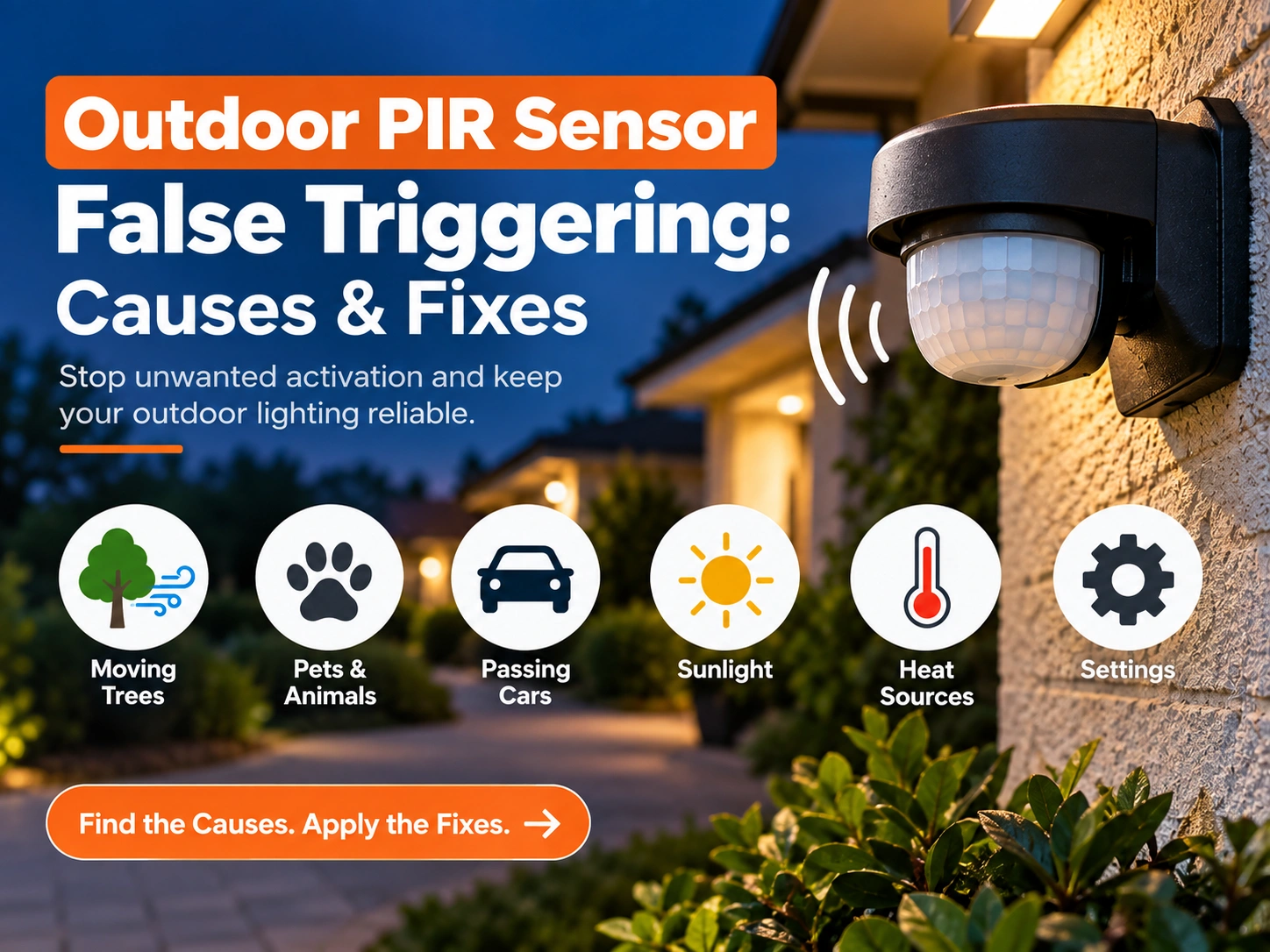
Quick Answer: To stop an outdoor PIR sensor from false triggering, first check what is moving or changing inside its detection area.
Trees, plants, pets, passing cars, sunlight, heat sources and nearby people can cause unwanted activation.
Start by removing moving objects from the sensor’s view. Then check the sensor angle, reduce its sensitivity slowly, and make sure it is not facing a road, bright sunlight, hot air vent or reflective surface.
Clean the PIR lens and check the manufacturer’s settings. If the sensor still triggers for no clear reason, the wiring, fitting or sensor may need to be checked by a expert electrician.
What Is Outdoor PIR Sensor False Triggering?
Outdoor PIR sensor false triggering happens when a passive infrared sensor detects something that it thinks is movement, even though there is no person that you want it to detect.
For example, your outdoor security light may turn on when nobody is near your home.
This can happen because a PIR sensor reacts to changes in infrared energy. Outdoor areas have many things that can create these changes.
Common examples include:
- Moving tree branches
- Leaves and plants
- Cats and dogs
- Foxes and other wildlife
- Passing cars
- People walking on a nearby pavement
- Direct sunlight
- Hot walls
- Air vents
- Heat from equipment
- Rain and changing weather
- Incorrect sensor settings
- Reflective surfaces
Current PIR troubleshooting guidance also identifies moving vegetation, traffic, animals, heat sources, sunlight and sensor positioning as common causes of unwanted activation.
The good news is that many false-trigger problems can be reduced by changing the sensor’s position or settings.
Common Causes of Outdoor PIR Sensor False Triggering
Before replacing the sensor, try to find the actual cause.
| Cause | What may happen | First check |
|---|---|---|
| Moving branches | Light turns on during wind | Look around the detection area |
| Pets | Light activates at night | Check for animals |
| Passing cars | Light activates near a road | Check sensor direction |
| Direct sunlight | Unwanted daytime activation | Check sun position |
| Hot air | Sensor activates near vents | Check nearby heat sources |
| High sensitivity | Small changes trigger the sensor | Reduce sensitivity |
| People outside the target area | Light activates unexpectedly | Adjust detection direction |
Finding the cause is important because simply turning the sensitivity very low may also stop the sensor from detecting a genuine person.
1. Check for Moving Trees and Plants
Trees, bushes and plants are one of the first things to check.
A PIR sensor can detect changes caused by moving vegetation, especially when branches or leaves move through its detection area.
The problem may be worse on windy days.
Walk around the area and look at everything inside the sensor’s field of view.
Ask yourself:
- Is a tree branch moving?
- Are leaves touching the sensor?
- Is a bush moving in the wind?
- Is a hanging plant moving?
- Is long grass moving?
- Is a garden decoration moving?
If you find something moving, trim it or change the sensor’s direction.
Official UK security guidance also notes that wind and blowing vegetation can affect PIR detection and contribute to false alarms.
2. Check Passing Cars
If your outdoor PIR sensor faces a road, passing cars can cause unwanted activation.
This is especially common when the sensor has a wide detection area.
For example, a sensor installed near a driveway may detect movement from the road instead of only detecting people entering your property.
What you can do
Try to:
- Turn the sensor away from the road.
- Reduce the detection area if your model allows it.
- Reduce sensitivity gradually.
- Change the sensor angle.
- Position the sensor towards the area you actually want to monitor.
Do not reduce sensitivity so much that a person can walk onto your property without being detected.
The aim is to remove unwanted areas from the detection field, rather than simply making the sensor weak.
3. Check Cats, Dogs and Other Animals
Small animals can also activate outdoor motion sensors.
A cat walking through the garden can create a different heat pattern from the background. Depending on the sensor and its settings, this can trigger the light.
Check for:
- Cats
- Dogs
- Foxes
- Birds close to the sensor
- Rodents
- Other wildlife
If animals are causing the problem, changing the sensor’s height, angle or detection area may help.
Do not place the sensor where animals regularly pass if you only want to detect people.
4. Reduce the PIR Sensor Sensitivity
Most outdoor PIR sensors have a sensitivity or range control.
It may be marked:
- SENS
- Sensitivity
- Range
- Detection
If the sensitivity is too high, small changes in the detection area may trigger the light.
Try reducing the setting a little.
Then wait and test the sensor.
Do not turn it from maximum to minimum straight away.
A better method is:
High → test → slightly lower → test → slightly lower → test
This helps you find a setting that reduces false activation while still detecting people.
Many PIR fittings use separate controls for sensitivity, time and daylight/LUX, although the exact controls vary by manufacturer.
5. Check the Sensor Direction
Sensor direction is extremely important.
A PIR sensor does not need to face the area directly in front of your door.
Sometimes it works better when movement crosses its detection zones.
For example:
Less useful:
Person → Sensor
Often more effective:
Person → → → Sensor detection area
A person’s movement across the detection zones can produce a stronger change than movement directly towards the sensor. Manufacturer guidance commonly recommends careful positioning and a mounting height around 2–2.5 metres, but you should always follow the instructions for your specific fitting.
6. Keep Direct Sunlight Away From the Sensor
Sunlight can create problems for PIR sensors.
The sun can heat surfaces inside the detection area. Changes in sunlight and shadows can also affect infrared conditions.
This means you should think about where the sun is:
- In the morning
- At midday
- In the afternoon
- Around sunset
If the sensor receives strong direct sunlight, consider changing its position or angle.
UK security guidance specifically warns that direct sunlight and changing sunlight conditions can contribute to false PIR alarms.
7. Look for Heat Sources
PIR sensors detect changes in infrared energy, so nearby heat sources can cause problems.
Check for:
- Boiler exhausts
- Extractor outlets
- Air-conditioning units
- Heating vents
- Warm machinery
- Outdoor lighting
- Hot walls
- Other equipment producing heat
Do not aim the PIR directly at a heat source.
A sensor manufacturer guide also lists air-conditioning, vents, heaters, flues, outdoor lights, cars, trees and shrubs as possible causes of false triggering.
8. Check Reflective Surfaces
Some outdoor areas have surfaces that can make sensor behaviour less predictable.
Examples include:
- Windows
- Pools of water
- Very bright walls
- Glossy surfaces
- Wet surfaces
Look at the complete detection area rather than only the sensor itself.
If the sensor works correctly in dry weather but starts triggering after rain, check for changes in the surrounding area.
9. Check the PIR Lens
A dirty or obstructed sensor lens can affect operation.
Look for:
- Dust
- Dirt
- Spider webs
- Insects
- Water droplets
- Condensation
- Mud
- Plant material
Switch off the relevant electrical supply if required by the manufacturer’s instructions before cleaning or working around the fitting.
Use a soft, clean cloth and follow the manufacturer’s cleaning instructions.
Do not open electrical equipment unless you are qualified and know the manufacturer’s requirements.
10. Check the Weather
Outdoor sensors have to work in changing weather.
Wind can move trees and plants.
Rain can change surfaces and visibility.
Temperature changes can also affect PIR detection conditions.
If the false triggering happens only during particular weather, record the pattern.
| Weather condition | Possible trigger | What to inspect |
|---|---|---|
| Wind | Moving plants | Trees and bushes |
| Heavy rain | Water and changing conditions | Ground and reflective surfaces |
| Hot weather | Warm surfaces | Walls and equipment |
| Strong sunlight | Infrared changes | Sensor direction |
| Cold weather | Different temperature contrast | Sensor settings |
| Frost | Changed surface temperatures | Detection area |
Outdoor conditions should be considered when positioning and troubleshooting PIR equipment.
11. Check the LUX Setting
Some PIR lights have a LUX or daylight control.
This controls the light level at which the fitting operates.
If the LUX setting is incorrect, the light may operate during daylight when you do not expect it to.
However, this is slightly different from a true movement false trigger.
If your light activates only during daylight, check the LUX setting first.
Follow the manufacturer’s instructions because the symbols and adjustment method can differ between products.
12. Check the Time Setting
The TIME control determines how long the light stays on after detection.
If the light remains on for a long time, it may appear that the PIR is repeatedly triggering.
For example:
A sensor detects movement → light stays on → another movement is detected → timer starts again.
This can make the light appear to be permanently active.
Set the time to a suitable period and then monitor it.
13. Use a Simple Outdoor PIR Troubleshooting Test
If you cannot find the problem, test one thing at a time.
Step 1: Watch the sensor
Stand somewhere where you can see the light.
Step 2: Record the trigger
Write down:
- Time
- Weather
- Wind
- Traffic
- Animal activity
- Sunlight
- Nearby people
Step 3: Check the area
Look for anything moving.
Step 4: Change one setting
Reduce sensitivity slightly.
Step 5: Test again
Do not change several things at once.
This makes it much easier to identify the actual cause.
Outdoor PIR Sensor False Triggering Troubleshooting Table
| Problem | Possible reason | Suggested action |
|---|---|---|
| Turns on when windy | Moving trees or plants | Trim vegetation |
| Turns on when cars pass | Road inside detection area | Reposition sensor |
| Turns on at night | Animals | Check garden activity |
| Turns on during sunny periods | Sunlight or warm surfaces | Change sensor position |
| Turns on near a vent | Warm air | Move sensor away |
| Turns on randomly | Sensitivity too high | Reduce sensitivity |
| Stays on for a long time | TIME setting | Adjust timer |
| Works during day | LUX setting | Check daylight control |
| Triggers after rain | Reflective/wet surfaces | Inspect detection area |
| Still triggers after adjustments | Possible equipment fault | Professional inspection |
Should You Replace an Outdoor PIR Sensor?
Not immediately.
First check the simple causes.
A sensor does not necessarily need replacement because it switches on unexpectedly.
Try:
- Cleaning the lens.
- Removing spider webs.
- Checking plants.
- Checking animals.
- Checking passing traffic.
- Checking sunlight.
- Checking heat sources.
- Adjusting sensitivity.
- Adjusting the sensor angle.
- Checking the manufacturer’s instructions.
If the sensor continues to activate without an obvious environmental cause, there may be an electrical, wiring, fitting or sensor fault.
At that stage, professional testing can help identify the problem.
When Should You Call an Electrician?
You should consider getting professional help if:
- The light repeatedly activates after normal adjustments.
- The fitting has damaged wiring.
- Water has entered the electrical fitting.
- The circuit trips.
- The light flickers.
- The sensor has visible damage.
- You smell burning.
- The fitting becomes unusually hot.
- You need to change fixed wiring.
- You are unsure how the fitting is connected.
Do not repeatedly reset a tripping circuit without finding the cause.
For homeowners who are unsure about electrical work, Local Electrical Solution can help investigate outdoor lighting and PIR sensor faults safely.
How Local Electrical Solution Can Help With PIR Problems
Local Electrical Solution can inspect the sensor location, detection area, settings and connected outdoor lighting when simple adjustments do not solve the problem.
A proper inspection can look at the complete installation rather than only the PIR sensor.
This can help identify whether the problem is caused by:
- Sensor position
- Incorrect settings
- Outdoor lighting
- Wiring
- Environmental conditions
- Damaged equipment
- A faulty sensor
The aim is to find the cause instead of simply reducing the sensor sensitivity.
Outdoor PIR Sensor False Triggering: Quick Checklist
Use this checklist before replacing your sensor.
| Check | Yes/No |
|---|---|
| Are tree branches moving? | ☐ |
| Are bushes inside the detection area? | ☐ |
| Can cats or dogs enter the area? | ☐ |
| Does the sensor face a road? | ☐ |
| Does direct sunlight hit the sensor? | ☐ |
| Is there a heat source nearby? | ☐ |
| Is the sensitivity too high? | ☐ |
| Is the sensor pointing at the correct area? | ☐ |
| Is the lens clean? | ☐ |
| Is there water or condensation? | ☐ |
Work through the list from top to bottom.
How to Prevent Outdoor PIR Sensor False Triggering
Prevention starts during installation.
Choose the sensor position carefully.
Try to keep the detection area away from:
- Busy roads
- Moving branches
- Hot air outlets
- Strong direct sunlight
- Areas used by pets
- Unwanted pedestrian routes
- Large reflective surfaces
Then adjust the sensor so that the important area is covered.
A well-positioned sensor should detect the movement you want while reducing unnecessary activity outside that area.
Final Thoughts
Outdoor PIR sensor false triggering is often caused by the environment rather than a completely failed sensor. Moving plants, animals, traffic, sunlight, heat sources, weather and incorrect settings can all affect outdoor motion detection.
Start with the easiest checks. Look around the detection area, clean the lens, check the sensor angle and reduce sensitivity slowly. If the problem continues, avoid guessing or changing electrical wiring yourself.
A qualified electrician can inspect the installation and determine whether the problem comes from the sensor, its position, the connected light or the electrical system.
Local Electrical Solution provides professional electrical support for homeowners who need help with outdoor lighting and PIR sensor problems.
FAQs About Outdoor PIR Sensor False Triggering
1. Why does my outdoor PIR sensor keep triggering when nobody is outside?
An outdoor PIR sensor can trigger when it detects changes that look like movement. Common causes include moving branches, pets, passing cars, sunlight, hot air, insects and high sensitivity. Start by checking everything inside the sensor’s detection area. Then adjust the sensor direction and sensitivity gradually. If the problem continues without an obvious cause, the sensor or electrical installation may need professional checking.
2. Can wind cause an outdoor PIR sensor to false trigger?
Yes. Wind can move branches, leaves, bushes, grass and other objects inside the detection area. These changes can cause unwanted PIR activation. If the sensor only triggers during windy weather, inspect the area around it first. Trim moving plants and reposition the sensor if needed. UK security guidance also recognises wind and moving vegetation as possible sources of false PIR alarms.
3. Can cats trigger an outdoor PIR sensor?
Yes, cats and other animals can sometimes trigger an outdoor PIR sensor. A small animal moving through the detection area can create enough infrared change for the sensor to activate. Check whether the sensor is aimed at a place where animals regularly walk. Changing the sensor angle, height or detection area may help reduce unwanted activation while keeping useful human movement detection.
4. Why does my PIR security light come on when cars pass?
A PIR security light can come on when vehicles move through its detection area. This is more likely when the sensor faces a road, driveway entrance or busy pavement. Try turning the sensor away from the traffic and reducing its detection range if the fitting allows it. The goal is to keep the road outside the area that the sensor needs to monitor.
5. Can sunlight cause PIR false triggering?
Yes. Strong sunlight and changing sunlight conditions can contribute to false PIR activation. Sunlight can heat surfaces and create changing infrared conditions. Check the sensor during different parts of the day to see when the problem happens. If sunlight is the cause, changing the sensor’s position or angle may help. UK security guidance recommends considering the sensor’s position in relation to rising and setting sunlight.
6. Should I reduce the sensitivity of my outdoor PIR sensor?
You can reduce the sensitivity if it is causing unwanted activation, but do it gradually. If you reduce it too much, the sensor may stop detecting genuine movement. Make a small adjustment, test the sensor and repeat if necessary. If sensitivity must be made extremely low to stop false triggers, the sensor’s position or detection area may be the real problem.
7. Can a spider make an outdoor PIR sensor trigger?
Yes. A spider, insect or web close to the PIR lens can sometimes affect the sensor. The insect may move directly across the sensor’s field of view, creating a noticeable change. Check the front of the sensor for spider webs, insects and dirt. Clean it according to the manufacturer’s instructions. If insects repeatedly cause problems, inspect the sensor location and surrounding area.
8. Why does my PIR sensor trigger more often in bad weather?
Bad weather can change the environment around a PIR sensor. Wind can move plants, while rain can change surfaces and create reflections. Temperature changes can also alter the difference between people and their surroundings. If false triggers happen mainly during certain weather, record the conditions and look for a pattern. This can help identify the actual cause instead of replacing the sensor unnecessarily.
9. How do I know if my outdoor PIR sensor is faulty?
A faulty sensor is more likely when it continues to trigger after you have checked vegetation, animals, traffic, sunlight, heat sources, settings and positioning. Other warning signs can include unusual behaviour, flickering, physical damage or electrical problems. Do not open or repair fixed electrical equipment unless you are qualified to do so. A qualified electrician can test the installation and determine whether replacement is needed.
10. Can an electrician fix outdoor PIR sensor false triggering?
Yes. An electrician can inspect the sensor position, settings, connected lighting and electrical installation. They can also check for wiring problems or a faulty sensor where appropriate. Local Electrical Solution can help homeowners who have tried normal adjustments but still experience repeated false activation. Professional troubleshooting is particularly useful when the problem involves fixed wiring, circuit faults, damaged equipment or water ingress.
Related Reading
For a broader explanation of PIR technology, detection, settings, installation and outdoor use, see the main how outdoor PIR sensors work on Local Electrical Solution.