
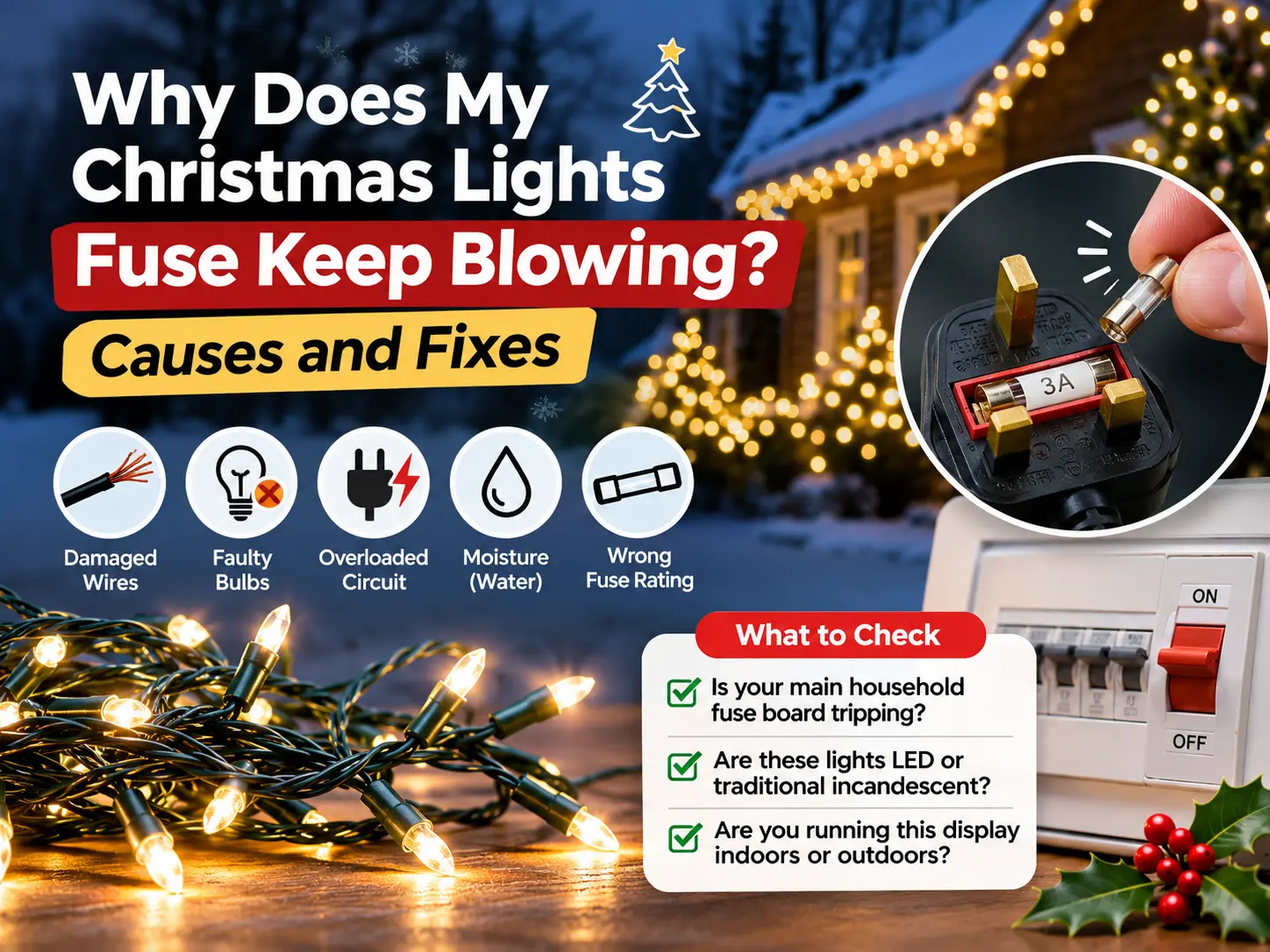
Quick Answer: A Christmas lights fuse keeps blowing because of a damaged wire, faulty bulb, short circuit, too many connected lights, or a faulty plug. First, check whether the small fuse inside the plug is blowing or your main household fuse board is tripping. Unplug the lights before checking them. Never use a bigger fuse to stop it blowing. If the problem keeps coming back, stop using the lights and ask a qualified electrician to check them.
Christmas lights make homes bright and festive during the winter. But a blown fuse can stop the lights from working. It can also be a sign of an electrical fault.
This guide explains why Christmas light fuses blow, how to find the problem, and how to prevent it in the UK.
Need professional outdoor Christmas lights installation? Tell us about your festive lighting plans and contact our team for an installation enquiry.
Fill in the details below to tell us about your outdoor Christmas lighting requirements. Our team will receive your enquiry through WhatsApp.
What Does It Mean When a Christmas Lights Fuse Keeps Blowing?
A fuse is a small safety part that helps protect an electrical circuit. It stops the flow of electricity when too much current passes through it.
Many Christmas lights have a small fuse inside their plug. This fuse can blow when there is an electrical fault or too much load.
However, not every Christmas light problem is caused by a blown fuse. A faulty bulb, broken wire, wet connection, or damaged plug can also stop the lights from working.
Common signs of a blown Christmas lights fuse
The whole string of lights stops working.
The lights do not turn on after plugging them in.
The fuse inside the plug looks damaged.
The lights work after changing the fuse but stop again soon after.
The household fuse board trips when you switch on the lights.
A blown fuse should not be ignored. It is important to find the cause before using the lights again.
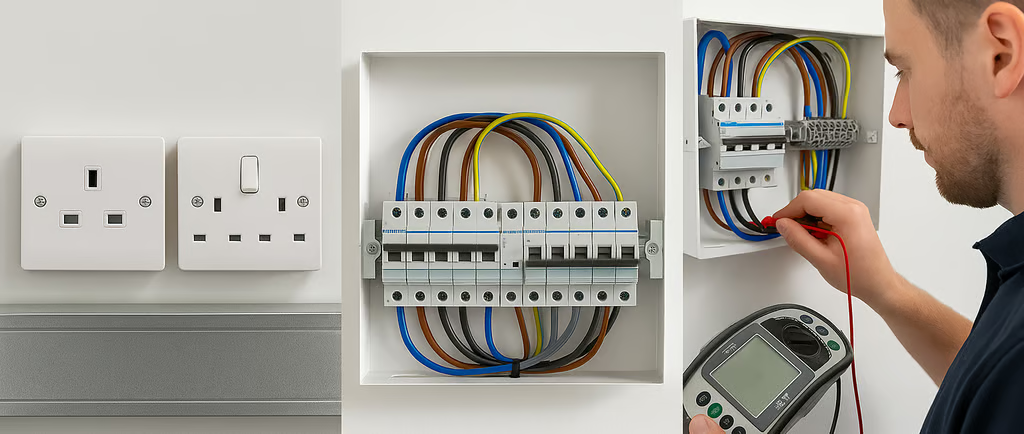
What Is the Difference Between a Christmas Lights Plug Fuse and a Household Fuse Board?
A small fuse inside the Christmas lights plug protects the light set. Your household fuse board protects the electrical circuits in your home.
These are two different safety devices.
| Electrical part | What it does | Common problem |
|---|---|---|
| Christmas lights plug fuse | Protects the light set from too much current | Small fuse blows |
| Household MCB | Protects a circuit from overload or short circuit | Circuit switch trips |
| Household RCD | Helps protect people from electric shock by detecting current leakage | RCD trips |
| Household RCBO | Provides overcurrent and residual-current protection | RCBO trips |
| Electrical socket | Supplies electricity to the lights | Loose or damaged socket |
Small fuse inside the Christmas lights plug
If the small fuse inside the plug blows, the whole string may stop working.
The problem may be caused by:
Too many connected lights
A faulty light set
Damaged wiring
A short circuit
A defective plug or connection
If the manufacturer allows fuse replacement, follow its instructions. Use only the correct fuse type and rating.
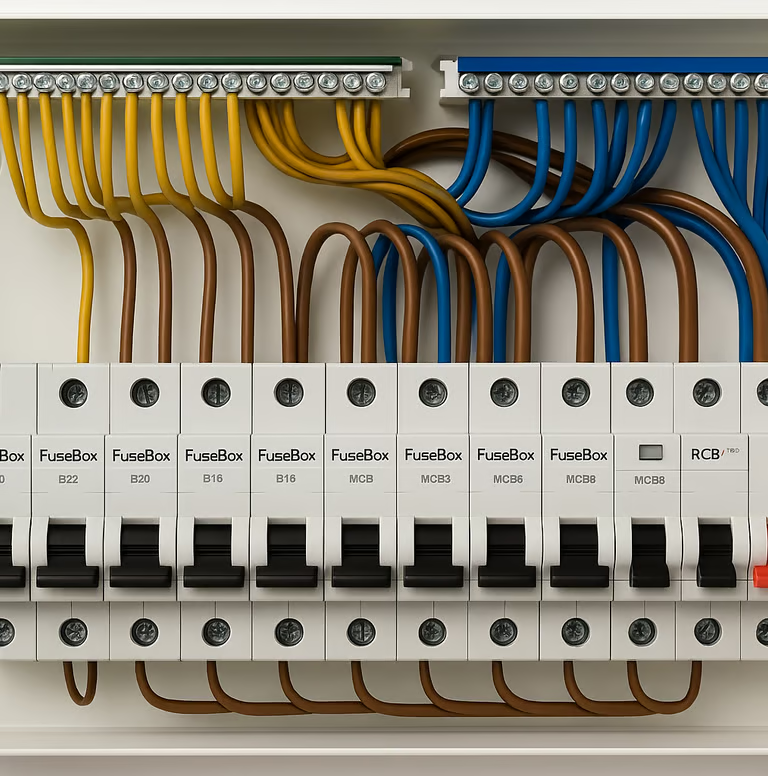
Main household fuse board
If your household fuse board trips, the problem may be more serious.
Possible causes include:
An overloaded circuit
A short circuit
Water entering outdoor electrical equipment
Damaged Christmas lights
A fault in the electrical installation
Do not keep resetting a household fuse board that trips when you switch on Christmas lights.
Unplug the lights if it is safe to do so. If the problem continues, contact a qualified electrician.
Why Does My Christmas Lights Fuse Keep Blowing? 7 Common Causes
There are several reasons why Christmas lights may keep blowing a fuse. The most common causes are damaged wires, too many connected lights, faulty bulbs, and moisture.
1. Connecting Too Many Christmas Lights Together
One common reason for a blown fuse is connecting too many Christmas light strings together.
Every light set has a limit. If you connect more lights than the manufacturer allows, the total electrical load may become too high.
This can cause a fuse to blow or a household circuit to trip.
Traditional incandescent Christmas lights use more electricity than LED lights. Connecting several incandescent light strings may put more load on the circuit.
How to prevent this problem:
Check the instructions on the Christmas lights.
Follow the maximum number of strings that can be connected.
Do not connect more lights than the manufacturer allows.
Use separate suitable power supplies where needed.
Ask an electrician if your display needs additional electrical points.
Do not assume that LED lights can be connected without a limit. Always follow the manufacturer’s instructions.
2. Damaged or Broken Christmas Light Wires
Christmas lights are often stored in boxes for many months. During storage, the wires may become damaged.
The wires can also be damaged when you hang lights around a tree, roof, or garden.
Common signs of damage include:
Cracked wire insulation
Exposed copper wire
Burn marks
Broken plugs
Loose connections
Wires damaged by pets
A damaged wire can cause a short circuit. This may lead to a blown fuse or a tripping household fuse board.
How to fix it:
If you find damaged wires, stop using the lights.
Do not try to repair damaged Christmas light wiring with ordinary electrical tape. Do not cut the damaged section and join the wires yourself.
Replace the light set or ask a qualified electrician if the product is designed for professional repair.
3. A Faulty Christmas Light Bulb
A faulty bulb can sometimes stop a complete section of Christmas lights from working.
This is more common with traditional incandescent Christmas lights.
Some light sets use bulbs connected in series. In these sets, one failed bulb may stop the whole section from lighting.
LED Christmas lights work in different ways. A faulty LED may affect one bulb, one section, or the whole string.
| Bulb problem | What you may notice | Possible action |
|---|---|---|
| Loose bulb | One section may stop working | Check the manufacturer’s instructions |
| Broken bulb | A bulb is cracked or damaged | Replace the set or bulb if permitted |
| Failed incandescent bulb | A complete section may go dark | Use the correct replacement bulb |
| Faulty LED | One bulb or section may stop working | Check the product instructions |
| Damaged bulb socket | Lights may flicker or stop working | Stop using the light set |
A faulty bulb does not always cause a fuse to blow. If the fuse keeps blowing, there may be another problem with the wiring or electrical circuit.
4. Moisture in Outdoor Christmas Lights
Outdoor Christmas lights are exposed to rain, damp air, and cold weather.
If water enters a plug, socket, or electrical connection, it may cause an electrical fault.
This is especially important during the UK winter, when rain and damp conditions are common.
Signs of moisture damage include:
Water inside a plug or socket
Corrosion on metal contacts
Green or white marks on electrical connections
Lights that stop working after rain
A household RCD that trips when outdoor lights are switched on
How to prevent moisture problems:
Use lights that are designed for outdoor use.
Follow the manufacturer’s instructions for outdoor installation.
Keep electrical connections away from standing water.
Use suitable outdoor-rated extension leads and accessories.
Do not use damaged or wet electrical equipment.
Never open or handle wet electrical plugs while they are connected to the power supply.
If outdoor lights cause the household fuse board to trip, stop using them and arrange a professional check.
5. Using the Wrong Replacement Fuse
Christmas light plugs may contain small replaceable fuses.
If the original fuse blows, it must be replaced with the correct type and rating.
Using a fuse with a higher rating can be dangerous. It may allow too much current to pass through the wires before the fuse blows.
For example, if the manufacturer specifies a 3A fuse, do not replace it with a 5A fuse.
The correct rating depends on the product. Do not guess.
| Fuse problem | Why it is dangerous | Correct action |
|---|---|---|
| Higher-rated fuse used | May not protect the wiring properly | Use the specified rating |
| Wrong fuse type | May not fit or work correctly | Follow manufacturer instructions |
| Loose fuse | May cause poor contact | Stop and check the product guidance |
| Fuse blows repeatedly | May indicate a fault | Stop using the lights |
| No replacement rating available | The correct fuse is unknown | Contact the manufacturer |
A fuse is a safety device. It should never be changed to a higher rating just to keep the lights working.
6. Overloading a Household Electrical Circuit
Your Christmas lights may work correctly on their own but cause a problem when other electrical equipment is used on the same circuit.
For example, you may have:
Christmas lights
Electric heaters
Indoor decorations
Outdoor lights
Other electrical appliances
When the total load becomes too high, an MCB may trip.
This is different from a small fuse inside the Christmas lights plug blowing.
How to prevent an overloaded circuit:
Check the power requirements of your electrical equipment. Avoid connecting too many high-power appliances to one circuit.
If your household fuse board keeps tripping, ask a qualified electrician to check the circuit.
7. Old or Defective Christmas Lights
Christmas lights can become less safe as they age.
The wires, plugs, sockets, and bulbs may become damaged over time.
Even if the lights worked last Christmas, they may not be safe to use this year.
| Age or condition | Possible issue |
|---|---|
| New lights | Manufacturing fault |
| Lights stored badly | Damaged wires |
| Old incandescent lights | Failed bulbs or worn parts |
| Outdoor lights exposed to rain | Moisture damage |
| Lights with cracked insulation | Electrical fault |
| Lights that repeatedly blow fuses | Internal damage or short circuit |
If the lights keep blowing fuses and you cannot find a clear cause, replacing them may be safer than trying to repair them.
Is Your Main Household Fuse Board Tripping, or Is the Small Fuse in the Plug Blowing?
Before trying to fix Christmas lights, find out which electrical safety device is operating.
Small fuse inside the Christmas lights plug
If the small fuse inside the plug blows, the whole string may stop working.
The problem may be caused by:
Too many connected lights
A faulty light set
Damaged wiring
A short circuit
A defective plug or connection
You should unplug the lights and check the product instructions.
Main household fuse board
If the household fuse board trips, it may be an MCB, RCD, or RCBO.
The cause may be:
An overloaded circuit
A short circuit
Water entering outdoor electrical equipment
Damaged Christmas lights
A fault with a socket or electrical installation
Do not open the fuse board or try to repair its internal parts.
If the circuit continues to trip, contact a qualified electrician.
Are These Lights LED or Traditional Incandescent Bulbs?
The type of Christmas lights can change the way you find and fix a problem.
LED Christmas lights
LED Christmas lights use small light-emitting diodes. They usually use less electricity than traditional incandescent lights.
However, they can still develop electrical faults.
Common LED Christmas light problems include:
Faulty LED bulbs
Damaged wires
Failed power adapters
Moisture in outdoor connections
A blown plug fuse
A defective control unit
Some LED light sets use a low-voltage power adapter. If the adapter fails, the lights may stop working even if the bulbs are not damaged.
Check the manufacturer’s instructions before attempting any repair.
Traditional incandescent Christmas lights
Traditional incandescent lights use a small filament inside each bulb.
These lights usually use more electricity than LED lights and may become warm during use.
Common problems include:
Burnt-out bulbs
Broken filaments
Loose bulb connections
Damaged wires
Overloaded light strings
Some incandescent light sets have a special shunt inside each bulb. This helps keep electricity flowing when a bulb fails.
However, if the shunt also fails, the whole section may stop working.
Never replace an incandescent bulb with a different type unless the manufacturer says it is suitable.
Are You Running This Display Indoors or Outdoors?
Christmas light problems can be different depending on where you use the lights.
Indoor Christmas lights
Indoor lights are commonly used on Christmas trees, windows, and around the home.
Common problems include:
Too many light strings connected together
Damaged wires
Faulty bulbs
Overloaded sockets
Incorrect replacement fuses
Before using indoor lights, check that the wires and plugs are in good condition.
Do not place wires under carpets or rugs. Keep lights away from heat sources and follow the manufacturer’s instructions.
Outdoor Christmas lights
Outdoor lights need to be suitable for outdoor use.
They may be exposed to rain, wind, cold weather, and moisture.
Common problems include:
Water entering electrical connections
Damaged extension leads
Loose outdoor sockets
Faulty outdoor lights
Overloaded circuits
RCD tripping
Outdoor Christmas lights should be installed according to the manufacturer’s instructions.
If you need new outdoor electrical points or a safe power supply for a large display, contact a qualified electrician.
How to Fix Christmas Lights When the Fuse Keeps Blowing
The first step is to identify the problem. Do not keep replacing the fuse without finding out why it is blowing.
Step 1: Unplug the Christmas lights
Switch off the power and unplug the lights before checking them.
Never open a plug fuse compartment while the lights are connected to the electricity supply.
Step 2: Check the Christmas lights
Look for visible damage.
Check the wires, plug, bulbs, and connections.
If you find exposed wires, burn marks, cracked plugs, or damaged sockets, stop using the lights.
Step 3: Check the manufacturer’s instructions
Look at the label or instruction sheet.
Find out:
The correct fuse rating
The maximum number of connected light strings
Whether the lights are for indoor or outdoor use
Whether the bulbs can be replaced
Whether the power adapter is required
Step 4: Check the plug fuse
If the manufacturer allows the plug fuse to be replaced, follow the instructions provided.
Use only the correct fuse type and rating.
If the replacement fuse blows again, stop using the lights.
Step 5: Test one light string at a time
If the lights are designed to connect together, disconnect the strings and check them separately.
A light string may work on its own but cause a problem when connected to another string.
Do not exceed the connection limit given by the manufacturer.
Step 6: Check for a household fuse board problem
If the household fuse board trips, do not keep switching it back on.
Unplug the Christmas lights if it is safe to do so.
If the circuit continues to trip, contact a qualified electrician.
Step 7: Replace faulty Christmas lights
If the lights are damaged or keep blowing fuses, replacing them may be the safest option.
Do not try to repair sealed LED light sets or damaged mains wiring unless the product is designed for repair by a qualified person.
How to Stop Christmas Lights from Blowing a Fuse Again
Preventing a problem is better than fixing it during the Christmas season.
Follow these simple steps before installing your Christmas lights.
| Prevention tip | Why it helps |
|---|---|
| Check lights before installation | Finds damaged wires and plugs |
| Follow connection limits | Helps prevent electrical overload |
| Use the correct replacement fuse | Keeps the product’s safety protection |
| Choose suitable outdoor lights | Helps protect against weather |
| Keep connections away from water | Reduces moisture-related faults |
| Store lights carefully | Helps prevent wire damage |
| Replace damaged lights | Avoids unsafe electrical repairs |
| Use a qualified electrician for electrical work | Helps keep the installation safe |
Check your Christmas lights before every season
Do not wait until the lights are hanging on your roof or Christmas tree.
Check them before installation.
Look for damaged wires, loose bulbs, broken plugs, and signs of moisture.
If anything looks unsafe, do not use the lights.
Use LED Christmas lights where suitable
LED Christmas lights generally use less electricity than traditional incandescent lights.
This can help reduce the total electrical load of a Christmas display.
However, LED lights still need to be installed correctly. They must not be connected beyond the manufacturer’s limit.
Avoid unsafe electrical extensions
Do not connect extension leads together unless the manufacturer and electrical installation allow it.
Keep extension leads away from water and do not run them under rugs or carpets.
For outdoor displays, use suitable outdoor-rated electrical equipment.
How to Solve Christmas Lights Fuse Problems in the UK in the Future
Christmas lights are used for only a short period each year. This means many people may not notice electrical damage until they install them again.
The best way to avoid future problems is to check the lights before every Christmas season.
Future safety checklist for UK homeowners
Check the plug and cable for visible damage.
Check the correct fuse rating in the manufacturer’s instructions.
Check the maximum number of light strings that can be connected.
Use indoor lights only indoors.
Use suitable outdoor lights for external displays.
Keep outdoor connections away from standing water.
Stop using lights that repeatedly blow a fuse.
Contact a qualified electrician if the household fuse board trips.
When should you call an electrician?
You should contact a qualified electrician if:
The household fuse board keeps tripping.
Outdoor lights cause an RCD to trip.
You notice burning smells or burn marks.
A socket becomes hot or damaged.
You need additional outdoor electrical points.
You are planning a large Christmas lighting display.
You are unsure whether the electrical installation is safe.
A qualified electrician can inspect the electrical installation and help identify the cause of the problem.
Frequently Asked Questions
Why does my Christmas lights fuse keep blowing?
A Christmas lights fuse may keep blowing because of an overloaded light string, damaged wire, faulty bulb, moisture, or an internal electrical fault. Check the manufacturer’s instructions and stop using the lights if the fuse blows again.
Can I use a 5A fuse instead of a 3A fuse in Christmas lights?
No. You should use only the fuse rating specified by the manufacturer. A higher-rated fuse may not protect the wiring properly.
Why do my Christmas lights keep blowing a fuse when I plug them in?
This may indicate a short circuit, damaged wiring, a defective light set, or another electrical fault. Stop using the lights and check them according to the manufacturer’s instructions.
Why do Christmas lights work and then blow a fuse?
The problem may be caused by an electrical fault that develops during use, a damaged connection, moisture, or an overloaded circuit.
If the fuse keeps blowing, do not continue using the lights.
Can one faulty bulb cause Christmas lights to stop working?
Yes. Some Christmas light sets have bulbs connected in a way that allows one faulty bulb to stop a complete section from working.
The effect depends on the design of the light set.
Why do my outdoor Christmas lights keep tripping the fuse board?
Outdoor lights may cause the fuse board to trip because of water entering a connection, damaged wiring, an overloaded circuit, or an electrical fault.
Stop using the lights and contact a qualified electrician if the problem continues.
Are LED Christmas lights safer than traditional lights?
LED Christmas lights usually use less electricity and produce less heat than traditional incandescent lights.
However, they can still develop faults. Always use them according to the manufacturer’s instructions.
Should I replace Christmas lights if the fuse keeps blowing?
If the fuse keeps blowing and the cause cannot be found, replacing the lights may be safer.
Damaged or faulty light sets should not be used.
Can rain cause Christmas lights to blow a fuse?
Yes. Water entering electrical connections may cause a short circuit or other electrical fault.
Use outdoor-rated lights and keep connections protected from water.
Is it safe to repair Christmas lights myself?
You may be able to replace a manufacturer-approved plug fuse or bulb if the instructions allow it.
However, you should not repair damaged mains wiring, open sealed electrical components, or work inside a household fuse board unless you are qualified to do so.
Conclusion
Christmas lights that keep blowing a fuse can be frustrating, especially when you are decorating your home for the festive season.
The problem may be caused by too many connected lights, damaged wiring, faulty bulbs, moisture, or an electrical fault.
Start by identifying whether the small fuse inside the plug is blowing or your household fuse board is tripping. Check the lights carefully and follow the manufacturer’s instructions.
Never use a higher-rated fuse or continue using damaged lights.
If the problem keeps happening, stop using the lights and contact a qualified electrician.
Stay safe and enjoy a bright Christmas!