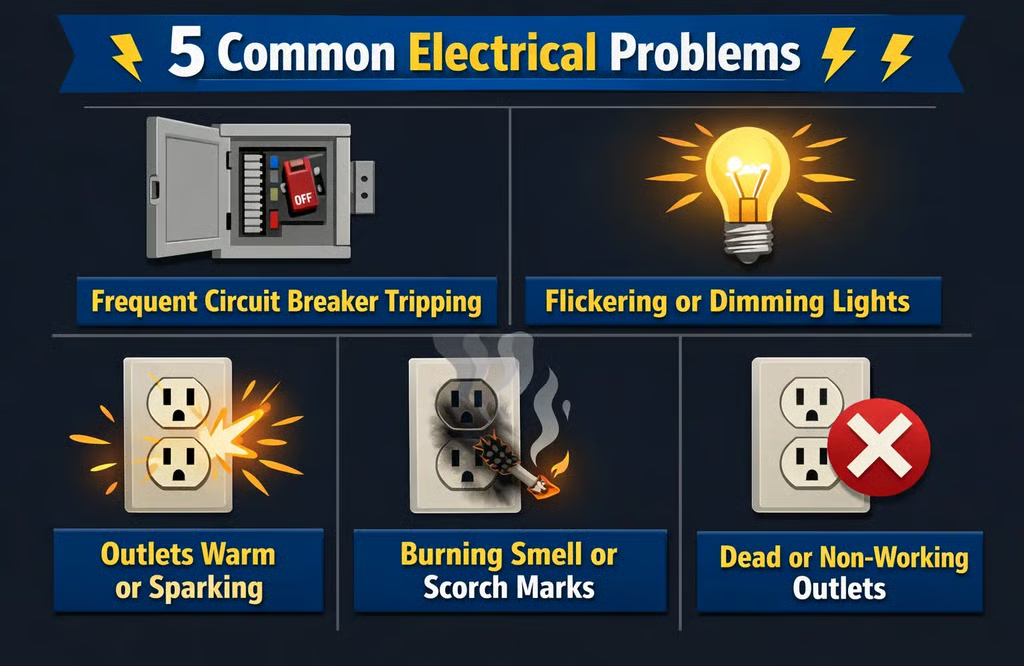
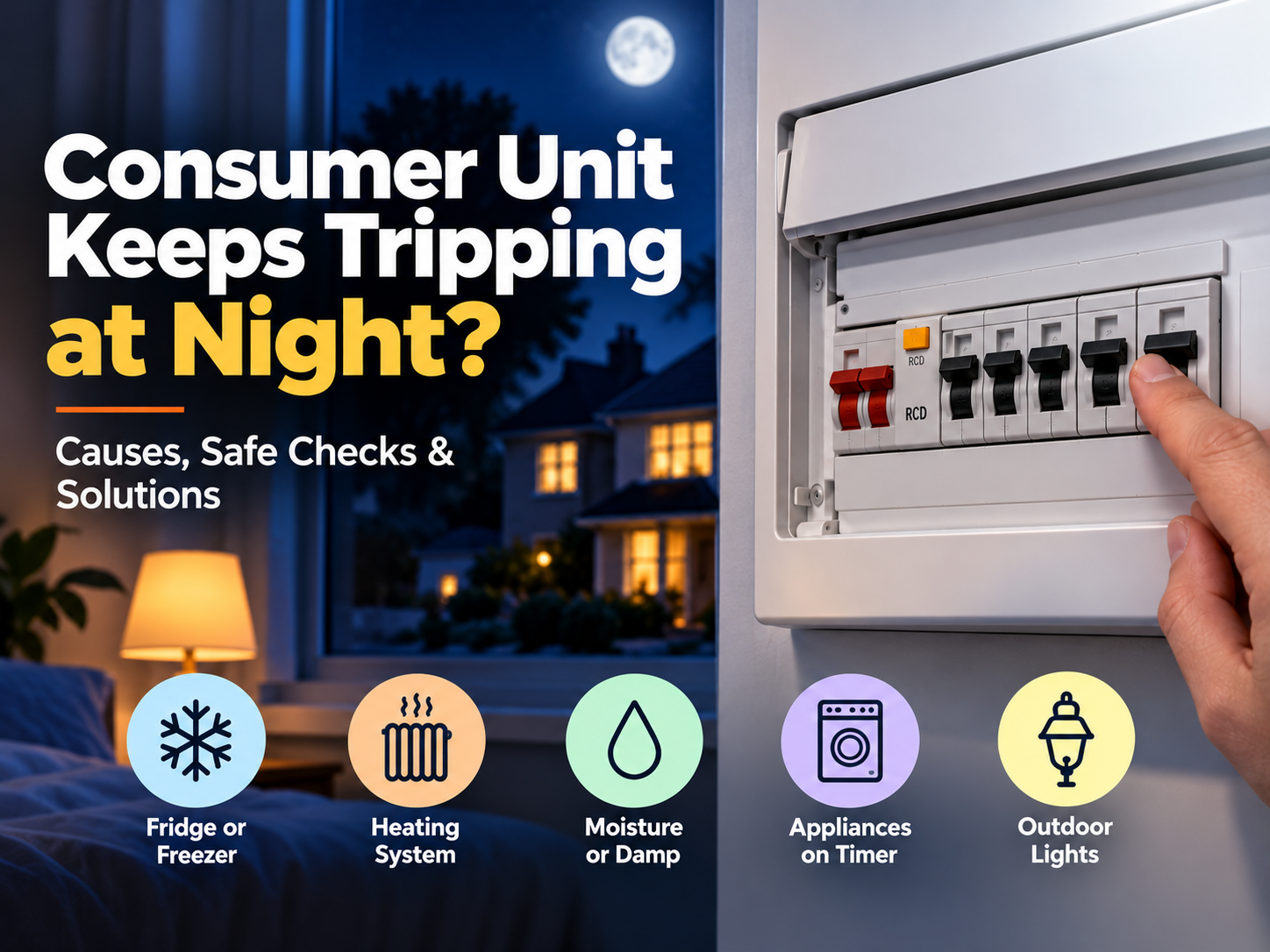
If your consumer unit keeps tripping at night, do not ignore it. The trip may be caused by an appliance that starts automatically, a heating system, moisture, damaged wiring, or a fault with the RCD or another protective device.
The good news is that the trip switch is there to protect your home. An RCD cuts the power when it detects an electrical problem that may cause electric shock.
Electrical Safety First says repeated RCD tripping should be investigated because the fault may be in an appliance or the wiring.
Quick Answer: Why Does My Consumer Unit Trip at Night?
Your consumer unit may trip at night because an electrical appliance or system starts running automatically.
Common causes include:
- Faulty fridge or freezer
- Immersion heater
- Electric heating system
- EV charger
- Washing machine or dishwasher on a timer
- Outdoor lights or garden equipment
- Moisture or condensation
- Damaged wiring
- Faulty appliance
- Ageing RCD, MCB or RCBO
- A problem inside the fixed electrical circuit
The time of the trip can give you an important clue.
Consumer Unit Keeps Tripping at Night?
Don't worry. Get help from Local Electrical Solution.

| When It Trips | Possible Cause | What It May Tell You |
|---|---|---|
| Soon after going to bed | Appliance or timer | Something may start automatically |
| Around the same time every night | Timer-controlled equipment | Check scheduled appliances |
| During cold nights | Heating system | Heating equipment may have a fault |
| After rain | Outdoor electrical fault | Water may have entered a socket or light |
| Early morning | Immersion heater or heating | A timed system may be starting |
| Randomly during the night | Wiring, appliance or RCD | Professional testing may be needed |
What Is a Consumer Unit?
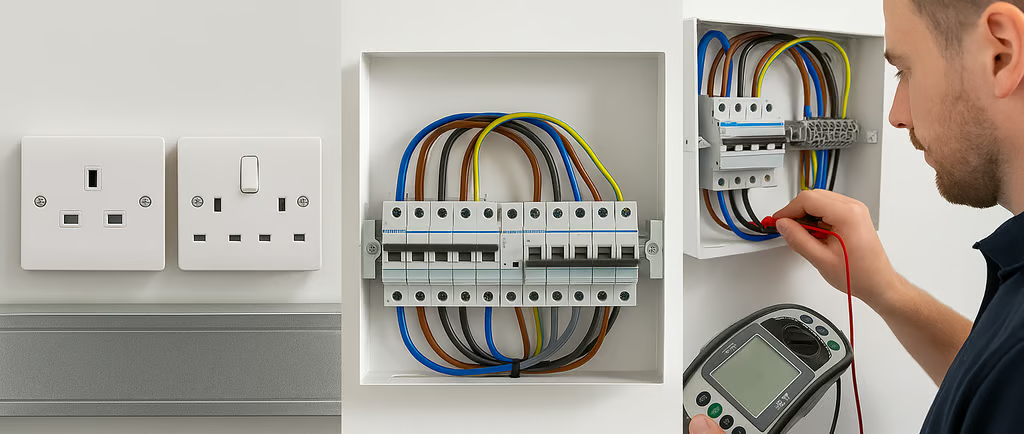
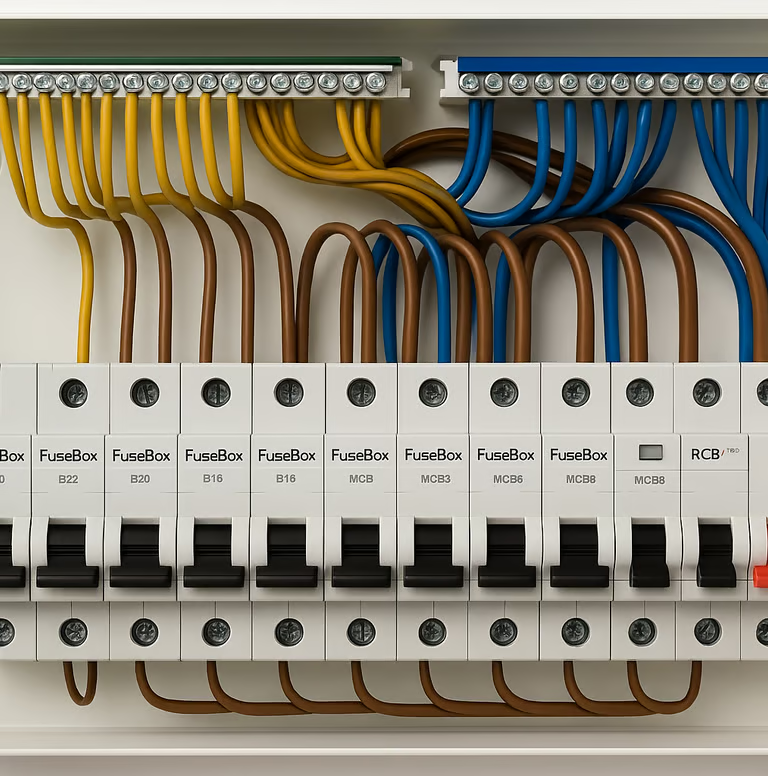
A consumer unit is the electrical box that controls the circuits in your home. Many people still call it a fuse box or fuse board.
Inside it, you may find different protective devices.
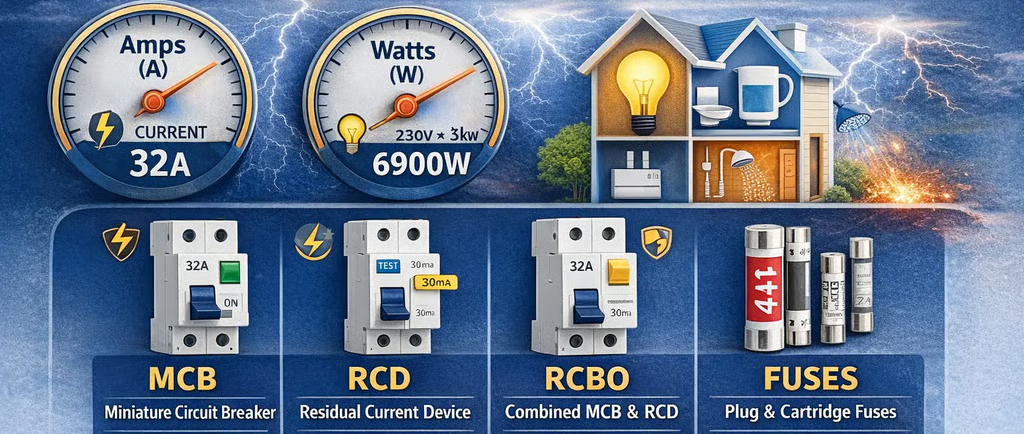
RCD
An RCD (Residual Current Device) watches the flow of electricity. If it detects an imbalance, it can switch off the power quickly.
This helps protect people from electric shock.
MCB
An MCB (Miniature Circuit Breaker) protects a circuit from problems such as overload or short circuits.
For example, one MCB may protect your kitchen sockets while another protects your lights.
RCBO
An RCBO combines protection against overcurrent with residual-current protection. Modern consumer units can use individual RCBOs for separate circuits.
Knowing which switch has moved can help an electrician understand where the problem may be.
Why Does the Consumer Unit Trip Only at Night?
This is one of the most common questions from homeowners.
The electrical fault may already be present during the day. You may simply not notice it because the equipment causing the problem is not running.
At night, many homes have equipment that switches on automatically.
For example, a heating system may start. An immersion heater may run. A fridge or freezer may start its cooling cycle. An EV charger may begin charging. Outdoor lights may come on using a timer or sensor.
When that equipment starts, a fault may cause the protective device to trip.
| Night-Time Equipment | Possible Problem | Possible Result |
|---|---|---|
| Immersion heater | Faulty heating element | RCD may trip |
| Fridge/freezer | Electrical fault or damaged component | Intermittent trip |
| Electric heating | Fault in heater or wiring | Circuit may trip |
| EV charger | Fault in charger or supply | RCD/RCBO may trip |
| Garden lights | Moisture or damaged cable | RCD may trip |
| Washing machine | Faulty motor or heater | Trip during cycle |
| Dishwasher | Water or electrical fault | Trip during operation |
1. A Faulty Appliance
A faulty appliance is one of the first things to consider.
An appliance can appear to work normally and still have an electrical fault.
The problem may only appear when the appliance starts a motor, heater or other internal part.
Common examples include:
- Washing machines
- Dishwashers
- Tumble dryers
- Fridges
- Freezers
- Ovens
- Electric heaters
- Kettles
- Outdoor equipment
If the trip happens after a particular appliance starts, that is useful information.
Do not keep using an appliance that repeatedly causes the consumer unit to trip.
Electrical Safety First advises people not to ignore repeated tripping, burn marks, buzzing or crackling sounds, or equipment that becomes hot.
2. Your Immersion Heater May Be Running at Night
An immersion heater can be a possible reason for a night-time trip.
Some homes use timers so the immersion heater operates at set times.
If the heating element has developed a fault, the RCD may trip when it starts.
This can explain why everything seems fine during the evening but the power is off when you wake up.
If the trip happens at almost the same time each night, tell the electrician the exact time. This can help them find the fault faster.
3. Your Heating System May Be Causing the Trip
Heating equipment can run automatically.
Depending on the system in your home, this may include:
- Electric heaters
- Heating pumps
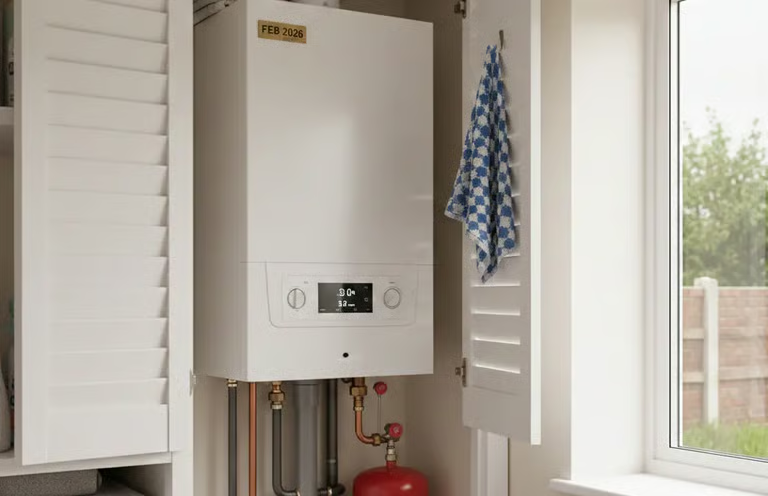
- Boilers and related electrical equipment
- Immersion heaters
- Storage heating
- Other timed heating equipment
A fault may only appear when the equipment starts.
Do not remove covers or attempt to repair electrical heating equipment yourself.
4. Your Fridge or Freezer Could Be the Problem
Your fridge and freezer may be working all night while you are asleep.
They do not run constantly. The compressor starts and stops to maintain the temperature.
If an electrical component has developed a fault, the consumer unit may trip when the compressor starts.
This is why a fridge or freezer can sometimes be difficult to identify as the cause.
If the power is off in the morning, note whether the fridge or freezer was running at the time.
5. Moisture Can Cause Night-Time Tripping
Water and electricity are a dangerous combination.
Moisture can enter electrical equipment, outdoor sockets, garden lights or other areas.
Condensation can also become a problem in damp areas.
Look for patterns such as:
- Tripping after rain
- Tripping on damp nights
- Garden lights causing the trip
- Outdoor sockets being involved
- Water near electrical equipment
- Damp walls near electrical fittings
If you see water, burning, damage or exposed wiring, do not touch the electrical equipment.
| Sign | Possible Concern | Safe Action |
|---|---|---|
| Trip after rain | Outdoor moisture | Stop using affected equipment |
| Wet socket | Water ingress | Do not touch it |
| Garden light causes trip | Outdoor wiring fault | Leave it off |
| Damp around electrical equipment | Moisture problem | Get it checked |
| Burning smell | Electrical overheating/fault | Switch off if safe and seek urgent help |
6. Outdoor Lights Can Trip the RCD at Night
Outdoor lighting is especially relevant to this problem because many garden lights turn on after dark.
If your consumer unit trips shortly after your garden lights come on, the timing is an important clue.
Possible causes include:
- Water inside a fitting
- Damaged outdoor cable
- Faulty LED driver
- Damaged connection
- Poor outdoor installation
- Moisture around a socket
Rotherham Electrician also identifies outdoor lights and garden sockets as possible causes when electrical trips follow weather or lighting timers.
Do not open an outdoor electrical fitting to investigate it yourself.
7. Damaged or Old Wiring
Sometimes the problem is not an appliance.
The wiring in the property may have a fault.
Old cables, damaged insulation, loose connections or other wiring problems can cause protective devices to operate.
This can be harder to find because the fault may not be visible.
Older electrical installations can need a proper inspection and testing. Electrical Safety First notes that older consumer units and wiring should be assessed rather than replaced simply because of age alone.
8. The RCD Itself May Have a Problem
Sometimes the protective device itself may need investigation.
If the RCD trips when there is no obvious appliance fault, an electrician can test the installation and the protective device.
Do not assume that replacing the RCD is automatically the answer.
The electrician should first establish why it is tripping.
A repeated trip is a symptom. The important job is finding the cause.
9. Could Too Many Appliances Cause the Trip?
Yes, but it depends on which protective device is operating and what type of fault is present.
If several high-power appliances are operating at the same time, an overloaded circuit can cause an MCB to trip.
However, an RCD operates for a different reason. It detects an imbalance in current rather than simply responding to too much electrical load.
This is why it is useful to identify which switch has tripped.
| Device | Main Job | Example Problem |
|---|---|---|
| RCD | Detects residual current | Leakage to earth |
| MCB | Protects against overcurrent | Overload or short circuit |
| RCBO | Provides both types of protection | Circuit fault or overcurrent |
| Main switch | Turns supply on/off | General isolation |
10. What Should You Check If Your Consumer Unit Trips at Night?
There are a few simple observations you can make safely.
Check the time
Write down the time the trip happens.
For example:
Monday – 2:10 am
Tuesday – 2:08 am
Wednesday – 2:11 am
A similar time each night may suggest that something is starting automatically.
Check which switch has moved
Look at the consumer unit without removing its cover.
Note whether the RCD, MCB or RCBO has moved to the off/tripped position.
Think about what runs at night
Ask yourself:
- Does the immersion heater run overnight?
- Is the heating timed?
- Does the EV charger start at night?
- Do garden lights switch on?
- Is a washing machine running?
- Is the dishwasher running?
- Is anything on a timer?
This information can help an electrician.
Can I Reset the Consumer Unit?
If the switch has tripped, you may be able to reset it once, provided there are no obvious danger signs and you can do so safely without opening or working inside the consumer unit.
Do not repeatedly reset a device that keeps tripping.
Electrical Safety First says repeated RCD tripping can indicate a fault that needs investigation.
If you notice burning, smoke, scorch marks, buzzing, crackling, heat or damaged electrical equipment, do not continue troubleshooting.
When Should You Call an Electrician?
Call a qualified electrician when the problem keeps happening or you cannot identify the cause.
You should get professional help if:
- The RCD keeps tripping
- The consumer unit will not stay on
- The trip happens with nothing obvious running
- You smell burning
- You see scorch marks
- A socket becomes hot
- You hear buzzing or crackling
- Outdoor electrics cause the problem
- The problem happens repeatedly overnight
- You suspect damaged wiring
Electrical Safety First specifically advises getting a registered electrician to investigate repeated RCD tripping.
What Will an Electrician Check?
A professional fault-finding visit is not just about resetting the switch.
The electrician may:
- Ask when the problem happens.
- Identify which protective device trips.
- Check the affected circuit.
- Test appliances where appropriate.
- Inspect visible electrical equipment.
- Test wiring.
- Check for insulation problems.
- Check the protective device.
- Look for moisture-related faults.
- Identify the source before recommending a repair.
The exact tests depend on the installation and symptoms.
How Local Electrical Solution Can Help
If your consumer unit keeps tripping at night, finding the cause is more important than repeatedly resetting the switch.
Local Electrical Solution can investigate electrical faults and help identify whether the problem is linked to an appliance, circuit, outdoor electrical system, heating equipment or another part of the installation.
Do You Need a New Consumer Unit?
Not every night-time trip means you need a new consumer unit.
The correct solution depends on the cause.
| Problem Found | Possible Solution |
|---|---|
| Faulty appliance | Repair or replace appliance |
| Damaged outdoor fitting | Repair or replace fitting |
| Moisture ingress | Find and correct source |
| Faulty wiring | Electrical repair |
| Damaged cable | Repair or replacement |
| Faulty protective device | Replace suitable device |
| Old or unsuitable installation | Further inspection and possible upgrade |
| Repeated circuit problems | Fault finding and suitable remedial work |
An older consumer unit is not automatically unsafe simply because it is old. Electrical Safety First recommends assessment of the installation, and an EICR can help establish its condition.
Consumer Unit Keeps Tripping at Night: Simple Checklist
Use this checklist before speaking to an electrician:
| Question | Your Answer |
|---|---|
| What time does it trip? | __________ |
| Which switch trips? | __________ |
| Does it happen every night? | __________ |
| Was it raining? | __________ |
| Was heating running? | __________ |
| Was an immersion heater running? | __________ |
| Was an EV charger running? | __________ |
| Were garden lights on? | __________ |
| Was a washing machine running? | __________ |
| Was a dishwasher running? | __________ |
This information can make fault finding easier.
Frequently Asked Questions
Why does my consumer unit trip in the middle of the night?
It may be caused by equipment that starts automatically, such as heating, an immersion heater, a fridge, an EV charger or timed outdoor lighting. A wiring or protective-device fault is also possible.
Why does my RCD keep tripping at night?
The RCD may be detecting current leakage from an appliance, wiring or another electrical system. Repeated trips should be investigated by a qualified electrician.
Why does my fuse box trip at the same time every night?
A fixed time can suggest that a timer-controlled appliance or system starts at that time. Write down the exact time and check what normally operates then.
Why does my electricity trip when I am asleep?
Something in your home can continue operating while you sleep. Heating, refrigeration, immersion heaters and other timed equipment may operate without anyone switching them on manually.
Can a fridge cause an RCD to trip?
Yes. A fridge or freezer can develop an electrical fault that becomes noticeable when its compressor or another component operates.
Can rain cause the consumer unit to trip?
Yes. Water or moisture entering outdoor electrical equipment can cause electrical leakage and protective devices may trip.
Should I keep resetting the RCD?
No. If it repeatedly trips, do not keep resetting it. The repeated trip may indicate an electrical fault that needs investigation.
Is a tripping consumer unit dangerous?
The trip itself is a safety action, but the reason for the trip may need attention. Burning smells, scorch marks, hot sockets, buzzing or damaged equipment should be treated seriously.
Do I need a new consumer unit if it keeps tripping?
Not necessarily. The cause should be found first. The problem may be an appliance, wiring, moisture, a protective device or another circuit fault.
Can an electrician find a night-time electrical fault?
Yes. Tell the electrician the exact time, which switch trips and what equipment normally runs at that time. These details can help guide the investigation.
Final Thoughts
If your consumer unit keeps tripping at night, do not simply reset it every morning and forget about the problem.
The night-time pattern can provide a useful clue. Look at the time, identify which protective device has tripped and think about equipment that starts automatically.
A faulty appliance, immersion heater, heating system, fridge, outdoor light, moisture problem, damaged wiring or protective-device fault could be involved.
If the problem keeps happening, Local Electrical Solution can help investigate the electrical fault and identify the cause.
For repeated trips, professional fault finding is safer than guessing. Local Electrical Solution can assess the symptoms and recommend the appropriate repair based on what is actually found.
Key Takeaway
A consumer unit that keeps tripping at night is usually giving you a warning that something needs checking. Find the cause rather than repeatedly resetting the switch.