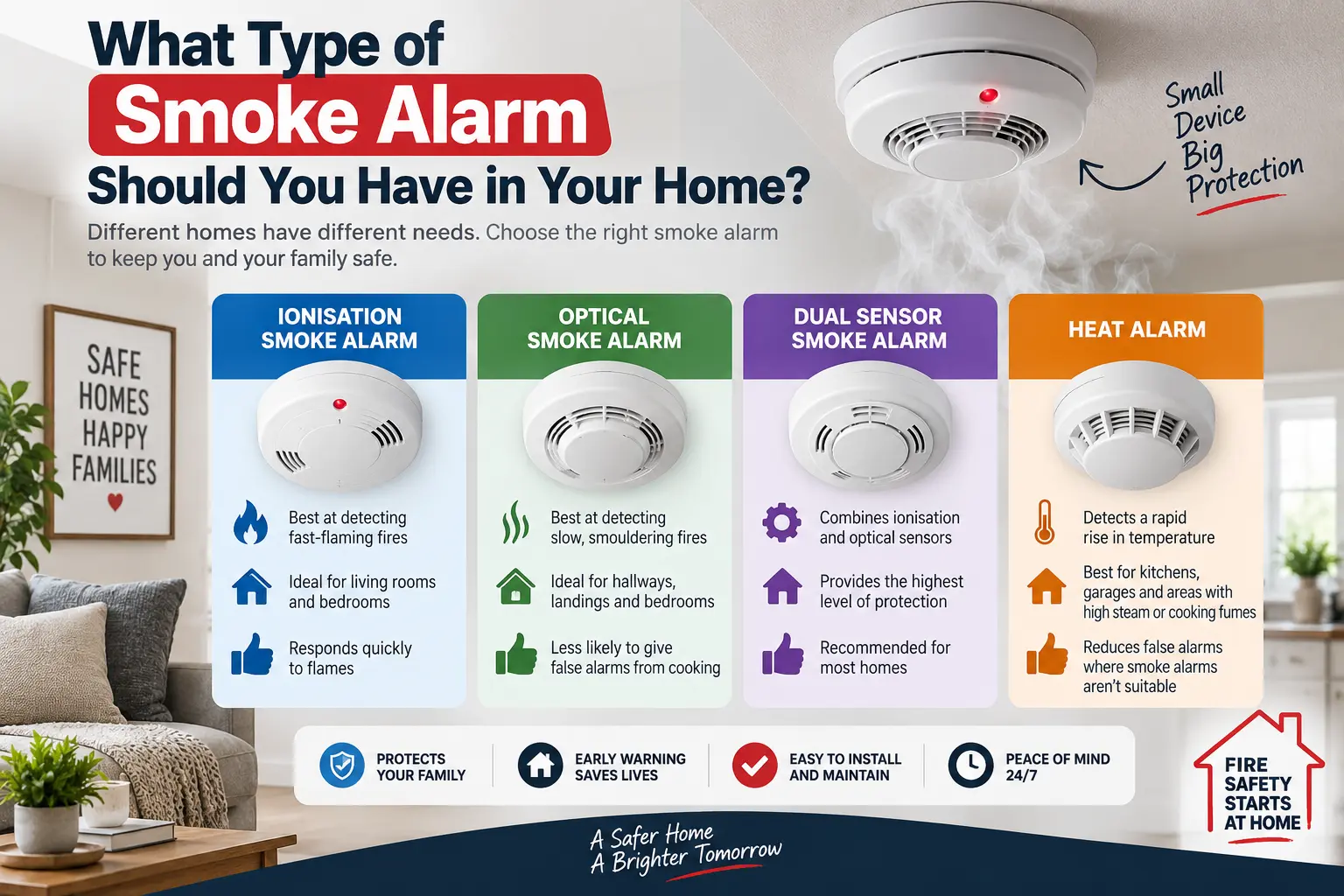
What Type of Smoke Alarm Should You Have in Your Home? The right smoke alarm depends on the room and your home’s needs.
For most bedrooms, living rooms and hallways, an optical smoke alarm is a good choice because it can detect smoke from slow-burning fires.
A heat alarm is often better for kitchens because cooking smoke and steam can cause false alarms.
You can also choose interlinked smoke alarms, which make all connected alarms sound when one detects smoke. Smart alarms can send alerts to your phone. If your home has a gas, oil or solid-fuel appliance, you may also need a carbon monoxide alarm.
Always check UK guidance and the manufacturer’s instructions.
Local Electrical Solution recommends looking at the room first, rather than simply buying the cheapest alarm.
Quick Answer: Which Smoke Alarm Is Best for Your Home?
If you want the simple answer, use this guide:
| Area of the home | Suitable alarm | Why |
|---|---|---|
| Bedroom | Optical smoke alarm | Good for slow-smouldering fires |
| Living room | Optical smoke alarm | Good general home protection |
| Hallway | Optical smoke alarm | Gives early warning when smoke spreads |
| Landing | Optical smoke alarm | Helps cover sleeping areas |
| Kitchen | Heat alarm | Less likely to react to normal cooking |
| Garage | Heat alarm | Better suited to fumes and dust |
| Home with several floors | Interlinked alarms | All alarms can sound together |
| Home with fuel-burning appliance | Smoke alarm + CO alarm where required | Fire and carbon monoxide are different risks |
| Person with hearing loss | Specialist alarm system | Uses visual or vibrating alerts |
Which? testing also shows that alarm performance can vary widely between products, and a higher price does not automatically mean better performance. Its recent testing included smoke alarms from different brands, power sources and technologies.
The Main Types of Smoke and Fire Alarms
Before choosing an alarm, it helps to know what each type does.
1. Optical Smoke Alarm
An optical smoke alarm is also called a photoelectric smoke alarm.
It uses a light sensor inside the alarm. When smoke enters the sensing chamber, it changes the light pattern and the alarm sounds.
Optical alarms are particularly useful for fires that produce a lot of smoke before large flames appear. This can include fires involving furniture, bedding and other household materials.
For many normal rooms in a house, an optical alarm is a sensible choice.
Example
Imagine a small fire starts in a bedroom at night. A mattress or piece of fabric may begin to smoulder before there is a large flame.
The room can slowly fill with smoke.
An optical alarm is designed to detect smoke particles and give you an early warning.
Which? describes optical or photoelectric alarms as a good choice for most rooms in the home, while noting that kitchens are better suited to heat alarms.
2. Ionisation Smoke Alarm
Ionisation alarms use a different sensing method and were traditionally associated with detecting fast-flaming fires.
However, ionisation technology is becoming less common in homes.
Which? says ionisation alarms are being phased out and recommends replacing an old ionisation alarm with an optical alarm when the unit reaches the end of its working life.
If you already have an older alarm, do not remove it simply because you read about another type online. Check the manufacturer’s information and the alarm’s age first.
Optical vs Ionisation Smoke Alarms
| Feature | Optical alarm | Ionisation alarm |
|---|---|---|
| Other name | Photoelectric | Ionisation |
| Sensor method | Light-based sensor | Ionisation chamber |
| Good for | Smouldering fires | Fast-flaming fires |
| Current popularity | Widely used | Becoming less common |
| Common choice for modern homes | Yes | Usually not the first choice |
| Replacement advice | Follow manufacturer guidance | Consider an optical replacement when old |
Local Electrical Solution generally recommends choosing an alarm based on the room and the current safety guidance rather than choosing an older technology simply because it is cheaper.
3. Heat Alarm
A heat alarm does not work like a normal smoke alarm.
Instead of looking mainly for smoke particles, it responds to heat reaching a set level or rising quickly.
This makes a heat alarm useful in places where normal activities could cause unwanted smoke alarm activations.
The kitchen is the best example.
Cooking can create steam, smoke, grease particles and heat. A normal smoke alarm placed too close to cooking may sound when there is no dangerous fire.
A heat alarm can be more suitable in this situation.
Which? also identifies heat alarms as suitable for places such as kitchens where smoke alarms may not be appropriate.
Where Are Heat Alarms Useful?
| Location | Smoke alarm | Heat alarm | Reason |
|---|---|---|---|
| Bedroom | ✓ | Usually no | Smoke detection is important |
| Living room | ✓ | Usually no | Early smoke warning |
| Hallway | ✓ | Usually no | Good escape-route coverage |
| Kitchen | Usually avoid close to cooking | ✓ | Reduces nuisance alarms |
| Garage | Often unsuitable | ✓ | Better for fumes and dust |
| Utility room | Depends on conditions | Possible | Consider the room’s risks |
| Boiler area | Depends on setup | Possible | Follow alarm instructions |
The exact position matters. A heat alarm should not be treated as a direct replacement for every smoke alarm in the house.
4. Multi-Sensor Fire Alarm
Some modern alarms combine more than one sensing method.
For example, a multi-sensor alarm may use smoke and heat detection. Some products also combine fire detection with carbon monoxide detection.
This can give one device more than one way to detect danger.
However, do not assume that a combination alarm is automatically the best choice for every room.
Look at:
- The room
- The type of fire risk
- The manufacturer’s instructions
- Required standards
- Whether the alarm can be interlinked
- Its power source
- Its expected working life
Which? currently lists multi-sensor fire and carbon monoxide alarms among the products it has tested.
5. Smart Smoke Alarms
Smart smoke alarms can send an alert to a smartphone or another connected device.
This can be useful if you are away from home.
For example, imagine you are at work and a smoke alarm detects a fire at home. A compatible smart system may send an alert to your phone.
But there is an important point:
A smart smoke alarm should still be able to sound its local alarm even if your internet connection is unavailable.
The smart connection is an extra feature. It should not replace the basic job of detecting danger and sounding an alarm.
Which? notes that smart alarms can send phone alerts, while the alarm itself can still sound when Wi-Fi is unavailable.
Smart Alarm: Pros and Cons
| Feature | Advantage | Possible drawback |
|---|---|---|
| Phone notification | Alerts you when away | Requires connected service for remote alerts |
| Local siren | Gives an alarm inside the home | Still needs correct placement |
| App | Useful for status information | App/service may change |
| Wi-Fi | Enables remote features | Internet is not guaranteed |
| Interconnection | Can improve whole-home warning | Must be compatible |
| Extra features | More information and control | Usually costs more |
6. Interlinked Smoke Alarms
An interlinked alarm system allows several alarms to communicate.
If one alarm detects danger, the other connected alarms can also sound.
This is especially useful in a large house.
Real-life example
Imagine you are sleeping upstairs.
A fire starts in the kitchen downstairs.
If only the kitchen alarm sounds, you may not hear it clearly from your bedroom.
With an interlinked system, the alarm upstairs can also sound.
That gives you a much better chance of hearing the warning quickly.
Which? tests whether interlinked smoke and heat alarms can activate together.
There are different ways alarms can communicate, including wired and wireless systems.
Some wireless systems use radio frequency rather than Wi-Fi.
Should You Choose Battery or Mains-Powered Alarms?
The sensor type is only one part of the decision.
You also need to think about how the alarm gets its power.
| Power source | Main benefit | Things to consider |
|---|---|---|
| Replaceable battery | Simple to install | Battery needs replacing |
| Sealed 10-year battery | Less regular battery work | Whole unit normally needs replacement at end of life |
| Mains powered | Permanent electrical supply | Installation may require an electrician |
| Mains + backup battery | Backup during power loss | More complex installation |
| Wireless interlinked | Easier interconnection in some homes | Batteries and compatibility need checking |
For Scotland, official guidance says homes can use sealed battery alarms with long-life lithium batteries or mains-wired alarms, and interlinked alarms are required.
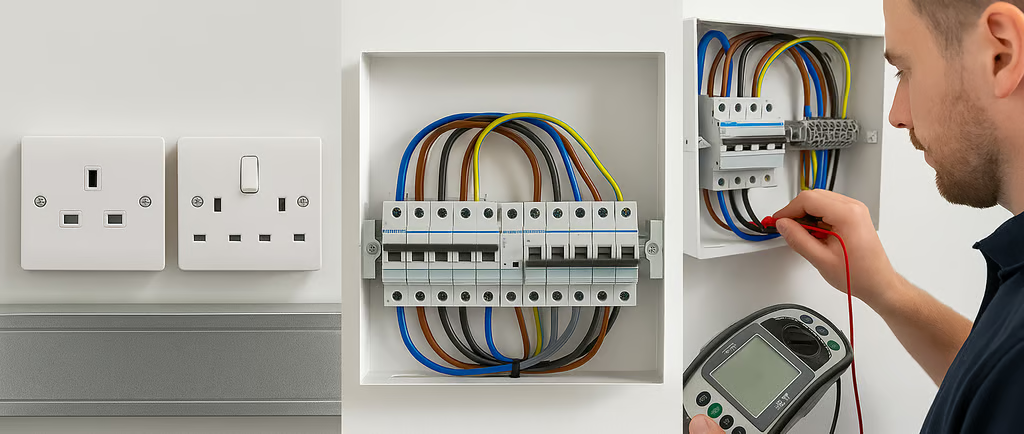
For a mains-powered installation, Local Electrical Solution recommends using a qualified electrician where electrical work is required.
Which Smoke Alarm Should You Choose for Each Room?
This is where many homeowners make mistakes.
They buy one type of alarm and put the same product everywhere.
Your home does not have the same fire risk in every room.
Bedroom
An optical smoke alarm is generally a sensible choice.
The main risk is that a fire can start while people are sleeping. Early smoke detection is important.
Keep the alarm in the correct position according to the manufacturer’s instructions.
Living Room
An optical smoke alarm is usually a good general choice.
Living rooms contain furniture, soft furnishings, electrical equipment and other items that can burn.
Hallway and Landing
These areas are important because they connect rooms and escape routes.
A correctly positioned smoke alarm can provide early warning if smoke moves into the circulation space.
Kitchen
A heat alarm is often more suitable than a standard smoke alarm close to cooking appliances.
The goal is not to remove fire protection. It is to use the right type of detection for the environment.
Garage
A heat alarm may be more suitable where vehicle fumes, dust or other conditions could cause problems for a smoke alarm.
Always check the alarm manufacturer’s permitted installation locations.
A Simple Room-by-Room Example
Let’s imagine a three-bedroom house with:
- One kitchen
- One living room
- Three bedrooms
- One hallway
- One upstairs landing
- One garage
Here is a simple way to think about the alarm plan.
| Room | Suggested alarm type | Main reason |
|---|---|---|
| Kitchen | Heat alarm | Cooking can cause nuisance smoke alarms |
| Living room | Optical smoke alarm | General fire detection |
| Hallway | Optical smoke alarm | Escape route warning |
| Landing | Optical smoke alarm | Protects sleeping area route |
| Bedrooms | Optical smoke alarms where appropriate | Early smoke warning |
| Garage | Heat alarm where suitable | Better suited to some garage conditions |
This is an example, not a universal installation plan. The final arrangement should follow the applicable rules, alarm manufacturer’s instructions and the design of the property.
How to Choose the Right Smoke Alarm: 7 Simple Steps
You do not need to be a fire alarm expert.
Follow these steps.
Step 1: Look at the Room
Ask:
What happens in this room every day?
Does someone cook there?
Is there a lot of dust?
Is it a bedroom?
Is it a garage?
Is it a normal living area?
The answer helps you select the right alarm technology.
Step 2: Decide Between Smoke and Heat Detection
For normal living and sleeping areas, smoke detection is usually important.
For areas such as kitchens, a heat alarm may be more suitable.
Do not put a normal smoke alarm in a difficult location just because you already own one.
Step 3: Choose the Sensor Technology
For many rooms, an optical or photoelectric alarm is a strong option.
If replacing an old ionisation alarm, check its age and manufacturer guidance.
Modern alarm choices should be based on current product information rather than simply copying an old installation.
Step 4: Check the Power Source
Ask yourself:
- Do I want a replaceable battery?
- Would a sealed long-life battery be easier?
- Does the property need mains-powered alarms?
- Do I need backup power?
- Do the alarms need to be interlinked?
For electrical installations, Local Electrical Solution can help homeowners understand whether a mains-powered system is appropriate.
Step 5: Think About Interlinking
A small home may have different needs from a large three-storey house.
If a fire starts far away from where you are sleeping, one alarm may not provide the same warning as a properly interlinked system.
This is one reason interlinking is an important feature to consider.
Step 6: Check the Standards and Instructions
Do not buy an alarm simply because it has a large number of reviews or a low price.
Check that the product is suitable for use in the UK and meets the relevant requirements.
Which? found that some cheap, unbranded alarms performed poorly in its testing, including products bought from online marketplaces.
Local Electrical Solution recommends buying from a reputable source and checking the product information before installation.
Step 7: Plan for Maintenance
Buying the alarm is not the end.
You should know:
- When it was installed
- When it needs testing
- When its battery needs attention
- When the complete unit should be replaced
- How to clean it
- What the warning sounds mean
Follow the manufacturer’s instructions for testing and maintenance.
What About Carbon Monoxide Alarms?
A carbon monoxide alarm is not the same thing as a smoke alarm.
A smoke alarm is designed to detect smoke from a fire.
A carbon monoxide alarm detects carbon monoxide gas.
You may need a CO alarm where there is a fixed combustion appliance, depending on the rules that apply to your property.
For example, England’s rules require relevant landlords to provide a carbon monoxide alarm in rooms used as living accommodation that contain a fixed combustion appliance, with an exception for gas cookers.
Scotland has its own requirements. Official Scottish guidance says a carbon monoxide detector is required where there is a carbon-fuelled appliance such as a boiler, open fire or wood burner.
So, do not buy a combined smoke and CO alarm simply because it sounds convenient. First understand what your home actually needs.
UK Smoke Alarm Rules: England, Scotland and Wales Are Not the Same
This is an important area that many general articles do not explain clearly.
The UK does not have one single rule that works exactly the same way in every nation.
England
For relevant rented properties, landlords must provide at least one smoke alarm on each storey where there is a room used as living accommodation.
They must also provide a CO alarm in rooms used as living accommodation where there is a fixed combustion appliance, excluding gas cookers.
The government guidance also says landlords must repair or replace faulty alarms once they have been informed and the fault is confirmed.
Scotland
Scotland has stronger whole-home requirements.
Official guidance says every home must have:
- A smoke alarm in the living room or room used most
- A smoke alarm in every hallway and landing
- A heat alarm in the kitchen
- Interlinked alarms
- A CO alarm where there is a relevant fixed combustion appliance
Wales
Wales also has its own requirements.
For rented homes, official Welsh guidance requires smoke alarms on every storey, and the required alarms must be connected to the dwelling’s electrical supply and linked to other smoke alarms connected to the electrical supply.
UK Comparison
| Location | Key point |
|---|---|
| England | At least one smoke alarm on each storey for relevant rented homes |
| Scotland | Interlinked smoke and heat alarm system requirements apply to all homes |
| Wales | Specific requirements for smoke alarms on every storey, including electrical connection and interlinking for required alarms |
| Northern Ireland | Check the current local requirements before choosing an installation |
| All areas | Follow product instructions and local fire safety guidance |
This is why a homeowner should not copy a smoke alarm setup from a website without checking where the property is located.
What Features Should You Look For?
The best alarm is not simply the one with the longest list of features.
Look for features that make sense for your home.
| Feature | Is it useful? | Best for |
|---|---|---|
| Optical sensor | Yes | Most normal living areas |
| Heat detection | Yes | Kitchens and suitable high-risk areas |
| Sealed 10-year battery | Very useful | Low-maintenance homes |
| Interlinking | Very useful | Larger or multi-storey homes |
| Smart alerts | Useful extra | People who want phone notifications |
| Test button | Essential | Regular testing |
| Hush/silence function | Useful | Temporary nuisance alarms |
| Escape light | Useful extra | Helping with visibility during an alarm |
| CO detection | Useful where required | Homes with relevant combustion appliances |
Which? also looks at factors such as sound output, detection performance and interlinking when testing alarms.
Do Not Choose a Smoke Alarm Only by Price
A £10 alarm may look attractive.
But fire safety is not the right place to choose based only on the lowest price.
Recent Which? testing found that some inexpensive and unbranded alarms failed smoke detection tests, while some less expensive products performed better than more expensive models.
The lesson is simple:
Cheap does not always mean bad, and expensive does not always mean best.
Look at:
- Product quality
- Relevant certification and standards
- Detection technology
- Power source
- Interlinking
- Manufacturer information
- Warranty
- Expected alarm life
- Suitability for the room
- Independent testing where available
A Simple Story: Choosing Alarms for a Family Home
Let’s take a simple example.
John lives with his wife and two children in a two-storey house.
At first, he buys the same cheap smoke alarm for every room.
He puts one near the kitchen because he thinks more alarms mean more safety.
A few days later, the alarm starts sounding while his wife is cooking.
There is no fire.
John becomes annoyed and starts thinking about removing the alarm.
This is the wrong solution.
Instead, he checks the room.
The problem is not that the home needs less fire protection. The problem is that the type and position of the alarm need to match the room.
He changes the kitchen arrangement to use suitable heat detection and keeps appropriate smoke alarms in the living and sleeping areas.
He also considers interlinking so that an alarm in one part of the house can warn people elsewhere.
This simple example shows why choosing the right alarm is more important than simply buying more alarms.
Local Electrical Solution recommends thinking about the whole home rather than treating every room as identical.
Common Mistakes When Choosing Smoke Alarms
Mistake 1: Putting a Smoke Alarm Too Close to Cooking
Cooking can create steam and smoke.
Use the manufacturer’s guidance when deciding where to position the alarm.
Mistake 2: Buying the Cheapest Alarm
Price should not be the only factor.
Check the product’s quality and compliance information.
Mistake 3: Using the Same Alarm Everywhere
A kitchen does not have the same conditions as a bedroom.
The right alarm can depend on the room.
Mistake 4: Forgetting Interlinking
In a large or multi-storey house, consider whether an interlinked system would give better warning.
Mistake 5: Forgetting About CO
A smoke alarm cannot replace a carbon monoxide alarm.
They detect different dangers.
Mistake 6: Ignoring an Old Alarm
Smoke alarms have a working life.
Check the manufacturer’s replacement advice and the date of the alarm.
Mistake 7: Installing a Mains Alarm Without Understanding the Electrical Work
Mains-powered alarms may require electrical installation.
If you are unsure, speak to a qualified electrician.
What Is the Best Smoke Alarm for Most Homes?
For many normal rooms in a UK home, an optical/photoelectric smoke alarm is a strong starting point.
For a kitchen, a heat alarm may be more suitable.
For a larger or multi-storey home, interlinked alarms can provide an important extra level of warning.
For homes with relevant combustion appliances, consider the need for a carbon monoxide alarm as well.
But there is no single alarm that is perfect for every room.
The right choice depends on:
- Your room
- Your home’s layout
- Your fire risks
- Your location in the UK
- Your power supply
- Whether you need interlinking
- Whether anyone in the home needs specialist warning equipment
- The manufacturer’s instructions
Frequently Asked Questions
What type of smoke alarm is best for a home?
An optical or photoelectric smoke alarm is a good choice for many normal rooms such as bedrooms, hallways and living areas. A heat alarm is often more suitable for kitchens.
Are optical smoke alarms better than ionisation alarms?
Optical alarms are widely used for modern homes and are particularly useful for detecting smoke from smouldering fires. Ionisation alarms are becoming less common, so check the age and manufacturer’s information if you have one.
Should I use a heat alarm in my kitchen?
A heat alarm is often suitable for kitchens because normal cooking can create smoke and steam that may cause nuisance alarms with smoke detectors.
Should smoke alarms be interlinked?
Interlinking can be very useful, especially in larger and multi-storey homes. When one alarm detects danger, the connected alarms can also sound.
Are smart smoke alarms worth it?
They can be useful if you want smartphone notifications and extra features. However, the basic alarm must still provide a local warning when danger is detected.
Do I need a carbon monoxide alarm as well?
A CO alarm is different from a smoke alarm. Whether you need one depends on the appliances in the property and the rules that apply to your home.
How often should I test my smoke alarm?
Follow the manufacturer’s instructions for testing. Regular testing is important because an alarm only protects you if it is working correctly.
Can I install a smoke alarm myself?
Some battery-powered alarms are designed for simple installation. Mains-powered alarms involve electrical work and may require a qualified electrician. Always follow the manufacturer’s instructions and applicable regulations.
What should I do if my old smoke alarm is an ionisation type?
Check its age and manufacturer’s instructions. If it has reached the end of its working life, consider replacing it with a suitable modern alarm. Which? says ionisation alarms are being phased out and recommends an optical replacement when an old unit reaches the end of its life.
Final Checklist: Choosing the Right Smoke Alarm
Before buying, ask these questions:
- Is this for a bedroom, living room, hallway or kitchen?
- Do I need an optical smoke alarm?
- Would a heat alarm be more suitable?
- Does my home need interlinked alarms?
- Should the alarm be mains powered?
- Would a sealed long-life battery be easier?
- Do I need a carbon monoxide alarm?
- Does the product meet the relevant UK requirements?
- Is the manufacturer reputable?
- Can I easily test and maintain it?
- When will the alarm need replacing?
- Does the installation follow the manufacturer’s instructions?
If you are unsure about the right alarm or need help with a mains-powered or interlinked system, Local Electrical Solution can help assess the requirements of your home and explain the available options.
Choosing the right alarm is not about buying the most expensive product. It is about choosing the right detection method, right location and right system for your home.
For most normal living areas, an optical smoke alarm is a sensible starting point. For kitchens, consider heat detection. For larger homes, consider interlinking. And always check the rules that apply to your part of the UK.
Local Electrical Solution can also help with electrical work connected with suitable alarm installations and other home electrical safety needs.