Learn what Earth Fault Loop Impedance is, how it works, why it matters for electrical safety, and how a loop impedance test ensures fast disconnection during an earth fault. Stay compliant and protected.
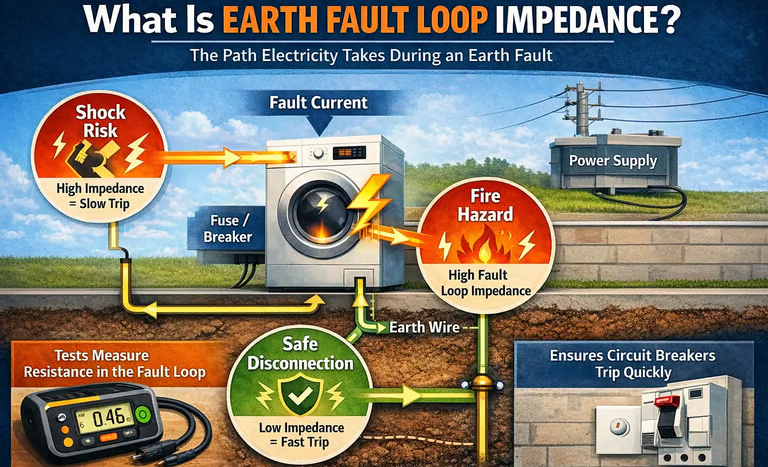
Earth Fault Loop Impedance is a safety measurement that shows how easily electricity can flow back to the power supply when a fault happens. If a live wire touches metal parts of an appliance, electricity needs a quick path to earth so the circuit breaker can switch off. That complete path is called the earth fault loop.
If the impedance (resistance) is low, the breaker trips quickly and keeps you safe. If it’s too high, the power may not disconnect fast enough, increasing the risk of electric shock or fire. Electricians test this to ensure your electrical system is safe.
What Is a Good Earth Fault Loop Impedance Reading?
There is no single earth fault loop impedance reading that is considered safe for every electrical circuit. The acceptable value depends on the protective device, circuit characteristics, earthing arrangement and requirements applicable to the installation.
In simple terms, the measured Zs value must be low enough for the protective device to disconnect the circuit within the required time when an earth fault occurs. An electrician therefore compares the measured result with the relevant maximum permitted value rather than judging the number on its own.
A lower impedance generally allows greater fault current to flow, helping the protective device operate quickly. However, the result must always be assessed in the context of the complete electrical installation.
What Happens If an Electrician Finds a High Zs Reading?
A high earth fault loop impedance reading does not automatically mean the entire property needs rewiring. The electrician first investigates why the impedance is higher than expected.
Possible causes include:
-
Loose or damaged protective conductor connections
-
Corroded terminals or connections
-
Poor earthing or bonding
-
Long cable runs
-
Undersized protective conductors
-
Problems with the earthing arrangement
-
Ageing or deteriorated wiring
The appropriate repair depends on the cause. An electrician may need to inspect connections, verify continuity, assess the earthing arrangement or make improvements to the circuit.
Does an RCD Replace Earth Fault Loop Impedance Testing?
No. An RCD and earth fault loop impedance testing provide different forms of electrical protection.
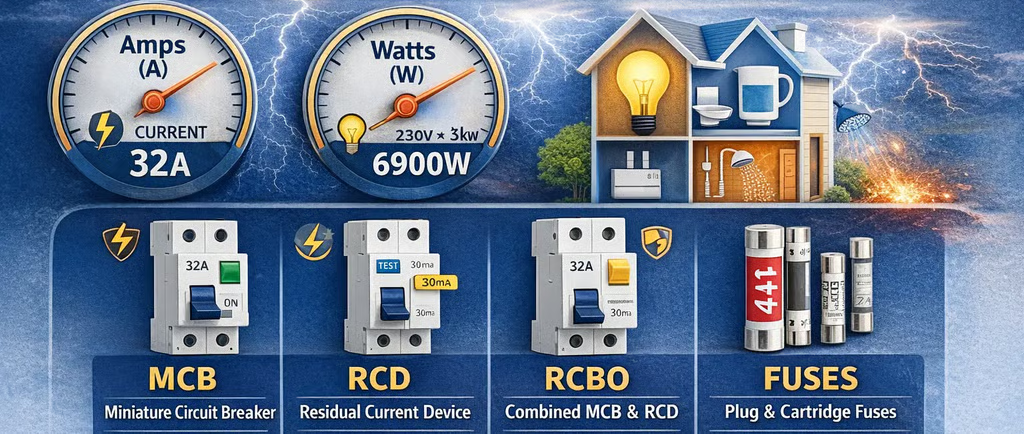
An RCD monitors current flowing through a circuit and can disconnect the supply when it detects an imbalance, such as current flowing to earth. Loop impedance testing, meanwhile, helps establish whether sufficient fault current can flow through the fault path for the relevant protective device to disconnect correctly.
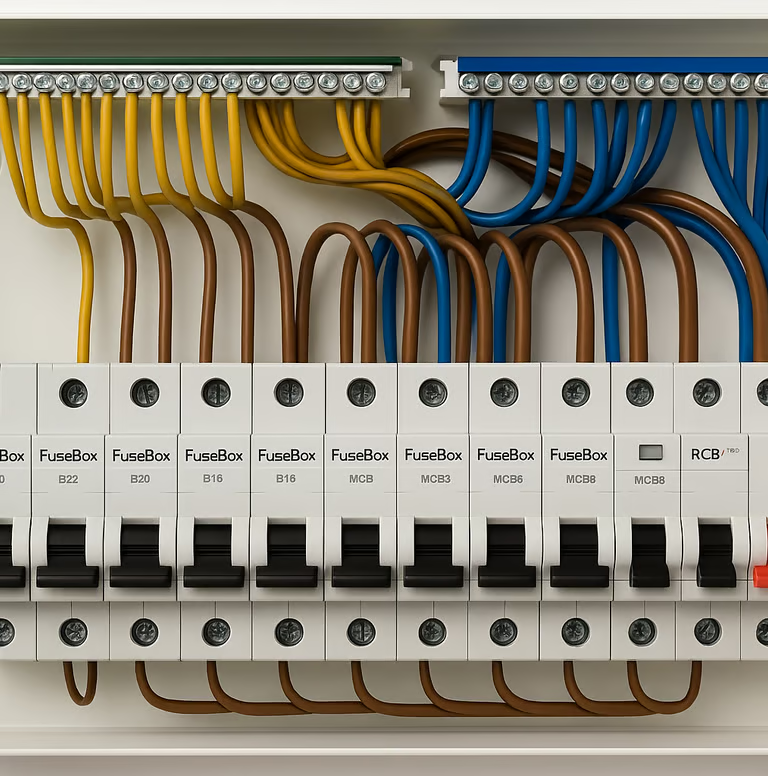
Modern installations may use RCBOs, which combine overcurrent protection with residual-current protection for individual circuits. Even where RCD or RCBO protection is installed, electricians still need to carry out the appropriate electrical tests required for the installation.
This is why an EICR or electrical installation testing should not be reduced to an RCD test alone.
Is Earth Fault Loop Impedance the Same as Insulation Resistance?
No. These are separate electrical tests that check different safety characteristics.
An earth fault loop impedance test assesses the impedance of the fault path and helps confirm effective automatic disconnection of supply.
An insulation resistance test checks the quality of insulation between conductors and earth or between conductors. Poor insulation can allow unwanted current leakage and indicate deterioration or damage.
Other tests, including continuity of protective conductors, polarity and RCD operation, may also form part of a complete electrical inspection.
Does the Earthing System Affect Loop Impedance?
Yes. The property’s earthing arrangement can influence the measured result and the way an electrician assesses electrical safety.
UK installations may use different earthing arrangements, including TN-S, TN-C-S and TT systems. A TT installation, for example, uses an earth electrode rather than relying on the distributor’s earth path in the same way as a TN system.
Because the characteristics of each system differ, an electrician must use the appropriate testing method and assessment criteria. This is particularly important when investigating unexpectedly high impedance.
When Is Earth Fault Loop Impedance Testing Carried Out?
Loop impedance testing can be relevant during several stages of electrical work, including:
-
New electrical installations
-
New circuits and alterations
-
Consumer unit replacement or upgrades
-
Electrical fault finding
-
Periodic inspection and testing
-
EICRs
-
Landlord electrical safety inspections
-
Commercial and industrial electrical maintenance
The exact tests required depend on the type and scope of the work being undertaken.
What Is Prospective Fault Current?
Electricians may also measure prospective fault current (PFC) during electrical testing. This indicates the level of current that could potentially flow during certain fault conditions.
Loop impedance and prospective fault current are closely related because lower impedance generally corresponds to higher prospective fault current. The results help an electrician assess whether protective devices are suitable for the installation.
What Should You Do If Your Test Result Is Unsatisfactory?
If an electrician reports that the earth fault loop impedance is too high, do not attempt to improve the reading by modifying wiring, removing protective devices or making temporary earth connections yourself.
Ask the electrician to explain:
-
Which circuit produced the high reading.
-
What the measured Zs value was.
-
What maximum value applies to that circuit.
-
What may be causing the high impedance.
-
Whether remedial work is recommended.
-
Whether further electrical testing is required.
Local Electrical Solution can investigate earth fault loop impedance concerns and explain what the results mean for the relevant electrical circuit.
For homeowners and landlords, understanding the result is just as important as having the test performed. A loop impedance measurement is not simply a number on an electrical certificate—it provides important evidence about whether the fault protection of a circuit is working as intended.
If your EICR identifies a high Zs value or another earthing concern, Local Electrical Solution can assess the installation and identify the appropriate next step rather than recommending unnecessary work.
For professional electrical testing across the West Midlands, Local Electrical Solution can assist with EICRs, fault finding, new installations and electrical safety assessments where appropriate.
Understanding the Basics of an Earth Fault Loop Impedance
When it comes to electrical safety, Earth Fault Loop Impedance is one of those topics that sounds technical but is actually quite straightforward once explained in plain terms.
It plays a key role in making sure electrical systems disconnect safely when something goes wrong.
An Earth Fault happens when a live wire comes into contact with metal parts that should not carry electricity, such as an appliance casing or metal conduit.
When this occurs, the electricity looks for the quickest and safest way back to the power supply. This return path is known as the Fault Loop.
The Earth Fault Loop is the complete route taken by fault current. It begins at the live conductor, passes through the fault point, travels along the earth and bonding conductors, and finally returns to the supply transformer. For safety devices to work correctly, this loop must allow current to flow easily.
This is where Fault Loop Impedance becomes important. It measures how much resistance the fault current faces while travelling around the loop.
Lower resistance means the current flows faster, allowing the circuit breaker or fuse to operate quickly. Higher resistance slows the current down and can prevent timely disconnection.
Why Earth Fault Loop Impedance matters:
- Ensures circuit breakers and fuses trip quickly
- Reduces the risk of electric shock
- Helps prevent electrical fires
- Keeps exposed metal parts from remaining live
- Confirms compliance with UK wiring regulations
- Highlights poor earthing or loose connections
- Improves overall electrical safety in a property
Loop Impedance testing is carried out by electricians during inspections and safety checks to confirm the system is safe.
Older wiring, damaged cables, corrosion, or poor earthing can all increase Earth Fault Loop Impedance, making testing even more important.
What is a Earth Fault Loop Impedance Test
An earth fault loop impedance test is a vital electrical safety check that confirms how quickly power will disconnect if an earth fault occurs. In simple terms, it measures how easily fault current can travel back to the supply, allowing protective devices to trip without delay.
During installations involving higher loads, an earth fault loop impedance test 3 phase is carried out to ensure all phases are safely protected and balanced. Electricians often refer to an earth fault loop impedance test diagram to clearly understand the fault current path before testing begins.
The test is performed using an earth fault loop impedance test instrument, which provides accurate readings without causing unnecessary disruption. A correct earth fault loop impedance test procedure includes checking external and internal loop values, confirming compliance with UK wiring regulations.
This test is essential for preventing electric shock, reducing fire risk, and ensuring every electrical system remains safe, reliable, and legally compliant.
Why Earth Fault Loop Impedance Is So Important
When we talk about electrical safety, few things are as important as earth fault loop impedance. In simple terms, the earth fault loop impedance definition refers to how easily electricity can flow back to the supply when a fault occurs. This flow needs to be quick and unrestricted so protective devices can do their job.
If earth fault loop impedance is too high, serious problems can arise. Circuit breakers may not trip within the required time, fuses may fail to blow, and exposed metal parts can remain live. This significantly increases the risk of electric shock and electrical fires. In everyday settings such as homes, shops, and workplaces, these risks can have life-changing consequences.
This is why UK wiring regulations are very strict about maximum permitted values. The faster a protective device disconnects the supply, the safer the installation. High impedance slows fault current down, delaying disconnection and leaving dangerous voltages present for longer than is safe.
Compliance With Wiring Regulations
To comply with BS 7671, every electrical installation must meet specific loop impedance limits. These limits ensure that protective devices operate within safe disconnection times under fault conditions. During testing, electricians measure both the external earth fault loop impedance (often referred to as Ze) and the total loop impedance (Zs) to confirm compliance.
Accurate earth fault loop impedance calculation is essential during installation, inspection, and fault finding. Electricians rely on calculated values alongside measured results to confirm that circuits are correctly designed. Poor earthing, long cable runs, loose connections, or ageing wiring can all increase impedance and push values beyond safe limits.
Practical earth fault loop impedance calculation examples are often used during design stages to predict whether a circuit will meet regulatory requirements before installation even begins. This helps prevent costly corrections later and ensures safety from day one.
Ultimately, earth fault loop impedance is not just a number written on a test certificate. It’s a critical safety measurement that protects people, property, and electrical systems. By keeping impedance within permitted limits, electricians ensure that faults are cleared quickly, risks are reduced, and installations remain safe, reliable, and fully compliant with UK regulations.
What Is the Earth Fault Loop Impedance Tool?
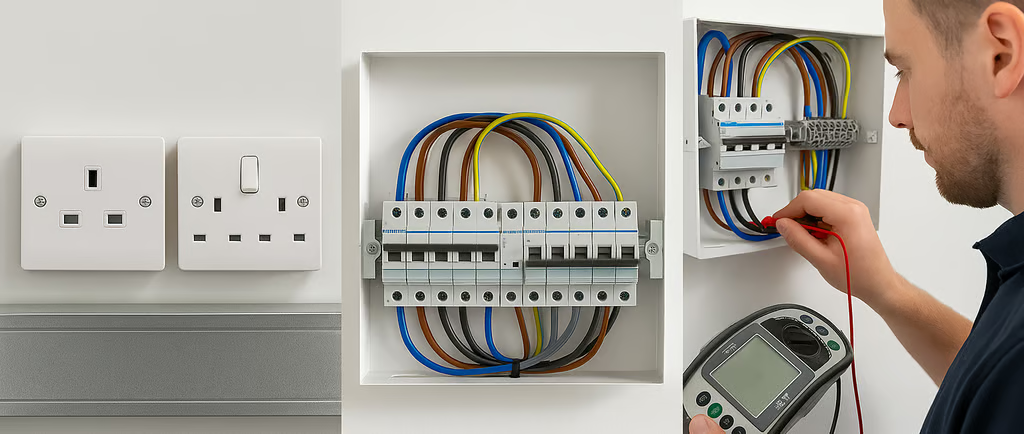
The tool used to measure earth fault loop impedance is called an earth loop tester, sometimes referred to as a loop impedance tester. It is a specialised electrical test instrument designed to check how easily fault current can flow back to the power supply during an earth fault.
An earth loop tester works by briefly creating a controlled test current between the live conductor and earth. It then measures the resistance (impedance) of that path and displays the result instantly. This reading helps electricians confirm that circuit breakers and fuses will disconnect within the required time limits.
Modern loop testers are safe, accurate, and designed to avoid unnecessary tripping of RCDs. They are commonly used during electrical installations, EICRs, fault finding, and commissioning of new circuits.
Without this tool, it would be impossible to properly verify electrical safety and compliance with UK wiring regulations.
Earth Fault Loop Impedance Formula
The earth fault loop impedance formula is used to calculate the total impedance of the fault path from the supply transformer, through the live conductor, to the point of fault, and back through the protective conductor to the source. In simple terms, it helps determine whether enough fault current will flow to quickly trip a protective device. The basic formula is:
Zs = Ze + (R1 + R2)
Here, Zs represents the total earth fault loop impedance at the point of the circuit. This value is critical in ensuring compliance with BS 7671 and confirming that disconnection times are met for safety.
Key Points:
- Zs = Total earth fault loop impedance
- Ze = External earth fault loop impedance
- R1 = Resistance of the line conductor
- R2 = Resistance of the circuit protective conductor
- The lower the Zs value, the higher the fault current
- Higher fault current ensures faster disconnection
- Always compare calculated values with measured test results
Is Earth Fault Loop Impedance Ze or Zs
Earth Fault Loop Impedance can refer to both Ze and Zs, but they are used in slightly different ways. Ze is the external earth fault loop impedance and is measured at the origin of the installation. It covers the supply side only, including the transformer, distributor’s cables, and the earthing system. This value gives a starting point for the electrical installation and is usually recorded once.
Zs is the total earth fault loop impedance of an individual circuit. It includes Ze plus the resistance of the live and earth conductors within that circuit. In everyday electrical work, Zs is the most important value because it confirms whether a protective device will disconnect quickly enough in the event of a fault.
- Ze is measured at the supply intake
- Zs is measured or calculated for each circuit
- Ze forms part of Zs
- Zs must meet BS 7671 limits
- Zs proves the circuit is electrically safe
What if the earth loop impedance be too high?
If the earth loop impedance is too high, electrical safety is seriously reduced. High impedance restricts the flow of fault current, which means protective devices such as circuit breakers and fuses may not operate within the required time. When this happens, electricity can remain on metal parts that should normally be safe to touch, creating a real risk to people and property.
In a fault situation, delayed disconnection increases the chance of electric shock and can also lead to overheating of cables or equipment. Over time, this can raise the risk of electrical fires. High earth loop impedance is commonly found in older installations or where earthing and bonding are inadequate, damaged, or poorly maintained.
- Circuit breakers may not trip quickly enough
- Fuses may fail to blow under fault conditions
- Metal parts can remain live
- Risk of electric shock increases
- Fire risk becomes higher
This is why high earth loop impedance must always be investigated and corrected to meet UK wiring regulations and maintain a safe electrical system.
How Electricians Reduce Earth Loop Impedance
When earth loop impedance readings are too high, it means the fault current cannot flow back to the supply quickly enough. This can delay the operation of circuit breakers or fuses, which increases the risk of electric shock or fire. Electricians focus on improving the earth path so protective devices disconnect within the required time set out in UK wiring regulations.
High impedance is often caused by ageing wiring, loose terminals, corrosion, poor bonding, or long cable runs. The solution depends on the cause, but the aim is always the same — reduce resistance and improve safety.
If readings are too high, electricians may:
- Upgrade undersized or damaged earth cables
- Improve or install main protective bonding
- Tighten, clean, or replace loose and corroded connections
- Improve the earthing arrangement, especially in TT systems
- Reconfigure circuits to shorten cable lengths
- Replace faulty protective devices if required
Lowering earth fault loop impedance improves disconnection times, ensures compliance with BS 7671, and most importantly, protects people and property from electrical hazards.
Professional Earth Fault Loop Impedance Testing Across the West Midlands
At Local Electrical Solution, we are proud to provide professional Earth Fault Loop Impedance testing across the whole of the West Midlands. With over 5 years of hands-on experience, we have built a strong reputation for delivering safe, reliable, and fully compliant electrical services in domestic, commercial, and light industrial properties. Our focus is always on safety, accuracy, and meeting the requirements of BS 7671 wiring regulations.
Earth Fault Loop Impedance testing plays a vital role in electrical safety. It ensures that protective devices such as circuit breakers and fuses will disconnect the supply quickly in the event of a fault. Our qualified electricians carry out precise testing, explain results clearly, and provide honest advice if improvements are needed. Whether you are a homeowner, landlord, business owner, or property manager, we tailor our service to suit your specific requirements.
We regularly carry out testing for new electrical installations, EICRs, landlord safety certificates, and fault-finding investigations. Covering Bedworth, Nuneaton, Coventry, Birmingham, Solihull, and all surrounding areas, we are well placed to support customers throughout the West Midlands. Our electrician headquarters are based at 99 Delamere Rd, Bedworth CV12 8SG, allowing us to respond quickly and efficiently.
Why choose Local Electrical Solution:
- Over 5 years of specialist experience in Earth Fault Loop Impedance testing
- Fully qualified and knowledgeable electricians
- Services for domestic, commercial, and light industrial properties
- Accurate testing in line with BS 7671 regulations
- Support for EICRs, landlord certificates, new installations, and fault finding
- Clear explanations and honest, practical advice
- Coverage across the entire West Midlands
If you need professional assistance or have concerns about electrical safety, please do not hesitate to call or email us. We are always happy to help. Reliable, professional, and safety-focused — Local Electrical Solution is here when you need us.