In an emergency? Call our team for a quick response +447544005547

What is the Difference between Watts & Amps
Learn the difference between watts and amps, including power, current, real-world examples, and why correct calculations are essential for safety.
Local Electrical Solution
2/8/20267 min read
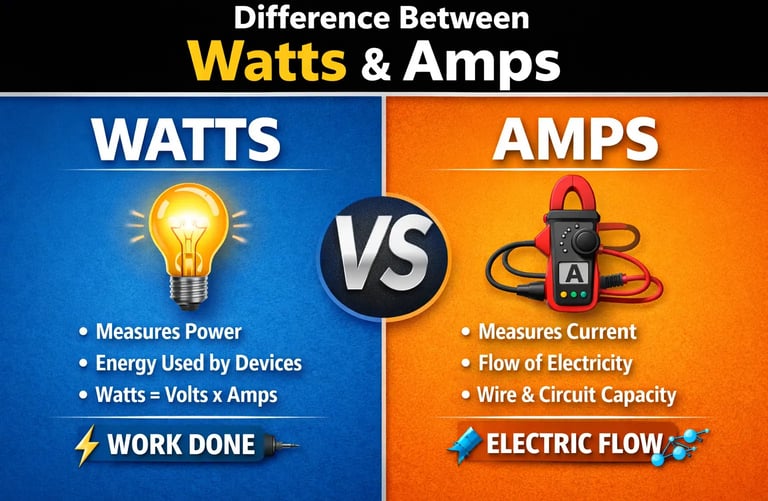
Understanding the difference between watts and amps is essential for electrical safety and efficiency. Amps measure the flow of electrical current, which affects wire heating, cable size, and circuit protection.
Watts measure electrical power, showing how much energy a device uses to perform work. Both are linked by voltage, and correct calculations help prevent circuit overloads, breaker tripping, and fire risks.
Amps are critical for wiring and safety decisions, while watts determine energy consumption and running costs. Knowing how watts and amps work together allows homeowners and electricians to design safe circuits, choose suitable appliances, and manage electricity use effectively.
1. What Are Amps?
1.1 Definition of Amps
Amps, also known as amperes, measure the flow of electrical current in a circuit. They indicate how much electricity is moving through a wire at a given time, which directly affects how the electrical system behaves under load.
Key points to understand about amps:
Amps measure electrical current flow, not power usage
Higher amp values mean more electricity is moving through the conductor
Increased current leads to higher heat generation in wires
All cables and protection devices are designed around maximum amp capacity
Understanding electrical current measured in amps helps determine whether a circuit is operating safely or approaching overload conditions.
Related Articles
1.2 How Amps Work in an Electrical Circuit
In an electrical circuit, current flows when voltage pushes electrons through a conductor. Appliances draw only the amount of current they require, based on their power demand and the supply voltage.
How amps behave in real circuits:
Switching on an appliance increases current flow in household wiring
Running multiple appliances increases the total amp load
Excessive current stresses cables and connection points
Continuous high current raises conductor temperature
This is why higher electrical load increases amp draw, especially in kitchens, workshops, and commercial installations.
1.3 Why Amps Are Important for Electrical Safety
Amps are critical for safety because excessive current is the main cause of overheating and electrical fires.
Important safety considerations related to amps:
Every cable has a maximum current rating
Circuit breakers and fuses are rated in amps, not watts
Exceeding amp limits causes insulation breakdown
Heat buildup can lead to arcing and short circuits
Correct amp load calculation for electrical safety ensures circuits remain within safe operating limits.
2. What Are Watts?
2.1 Definition of Watts
Watts measure electrical power, which represents how much useful work electricity performs. This includes producing heat, light, motion, or electronic operation.
Key characteristics of watts:
Watts show how hard electricity is working
Power is consumed whenever an appliance is operating
Higher wattage means higher energy demand
Watt ratings indicate appliance strength and performance
Electrical power measured in watts is the most common value displayed on appliances and equipment labels.
2.2 What Wattage Tells You About an Appliance
Wattage indicates how much power an appliance requires to function correctly. Appliances with higher watt ratings place a greater demand on the electrical system.
Examples of appliance wattage behaviour:
Low-watt devices use minimal energy
High-watt appliances draw significant power
Heating appliances typically have the highest watt ratings
Wattage helps estimate total circuit load
Understanding appliance wattage ratings and power consumption helps avoid overloading circuits.
2.3 Why Watts Matter for Energy Use and Cost
Watts are directly linked to electricity bills because energy usage is calculated over time.
How wattage affects energy cost:
Energy is measured in kilowatt-hours
Higher watt appliances consume energy faster
Longer operating time increases total consumption
Efficient appliances reduce overall electricity cost
This explains how wattage affects electricity bills in residential and commercial properties.
3. Difference Between Watts and Amps
3.1 Functional Difference Between Watts and Amps
Although closely related, watts and amps measure different aspects of electricity.
Key functional differences:
Amps measure how much electricity is flowing
Watts measure how much power electricity delivers
Amps relate to wiring and safety
Watts relate to energy use and performance
Understanding the difference between electrical current and electrical power prevents design and safety mistakes.
3.2 Mathematical Relationship Between Watts and Amps
Watts and amps are connected through voltage using a basic electrical formula.
Relationship highlights:
Watts = Volts × Amps
Increasing voltage reduces current for the same power
Lower voltage systems require higher current
Calculations are essential for circuit design
This is why calculating amps from watts and volts is standard practice in electrical work.
3.3 Practical Difference in Real-World Applications
In real installations, watts and amps serve different purposes.
Practical distinctions:
Amps determine cable size and breaker ratings
Watts determine appliance power and energy demand
Both values must be considered together
Ignoring either can cause system failure
The practical difference between watts and amps in electrical installations affects long-term reliability.
4. Calculating Watts and Amps
4.1 How to Calculate Amps from Watts
Calculating current helps ensure circuits are not overloaded.
Why this calculation is important:
Determines amp draw of appliances
Helps select correct breaker size
Prevents overheating of cables
Improves circuit safety
This method is widely used for amp draw calculation for household appliances.
4.2 How to Calculate Watts from Amps
Calculating power is useful when assessing total load or generator capacity.
Benefits of calculating watts:
Measures total circuit demand
Helps size inverters and generators
Prevents underpowered installations
Improves system efficiency
Knowing how to calculate electrical power in watts is essential for system planning.
4.3 Why Accurate Calculations Matter
Incorrect calculations can lead to serious problems.
Risks of poor calculations:
Circuit overloads
Frequent breaker tripping
Cable overheating
Appliance damage
Following electrical load calculation best practices protects both people and property.
5. Safety and Wiring Considerations
5.1 Why Wire Size Is Based on Amps
Wire size is determined by how much current it can safely carry.
Key reasons:
Higher current generates more heat
Thicker wires reduce resistance
Proper sizing prevents voltage drop
Safety standards rely on amp ratings
Using the correct wire size based on amp rating is essential for safe installations.
5.2 Role of Circuit Breakers and Fuses
Circuit protection devices prevent damage by stopping excessive current flow.
Their role includes:
Interrupting power during overload
Protecting cables and appliances
Reducing fire risk
Maintaining system stability
Amp-rated circuit protection devices are mandatory in modern electrical systems.
5.3 Common Electrical Mistakes to Avoid
Many electrical problems come from misunderstanding watts and amps.
Common mistakes include:
Ignoring total amp load
Overloading circuits with multiple appliances
Using undersized cables
Confusing watt ratings with current limits
Avoiding these errors ensures safe and efficient electrical system design.
6. Practical Examples of Using Watts and Amps
6.1 Bathroom Electrical Load Example
A typical bathroom contains high-power appliances, which makes watt and amp calculations extremely important.
Common bathroom appliances and wattage:
Electric shower: 8,500 watts
LED mirror light: 20 watts
Extractor fan: 30 watts
Total wattage calculation:
8,500 + 20 + 30 = 8,550 watts
Formula used:
Amps = Watts ÷ Voltage
Current calculation (230V supply):
8,550 ÷ 230 = 37.17 amps
Practical understanding:
High-watt bathroom appliances draw very high current
Dedicated circuits are required for electric showers
Correct cable size and breaker rating are essential for safety
6.2 Kitchen Electrical Load Example
Kitchens often have multiple high-watt appliances running at the same time.
Common kitchen appliances and wattage:
Kettle: 3,000 watts
Microwave: 1,000 watts
Toaster: 800 watts
Total wattage calculation:
3,000 + 1,000 + 800 = 4,800 watts
Formula used:
Amps = Watts ÷ Voltage
Current calculation (230V supply):
4,800 ÷ 230 = 20.87 amps
Practical understanding:
Running multiple appliances together increases total amp load
Overloading can cause breakers to trip
Load balancing across circuits improves safety
6.3 Living Room Electrical Load Example
Living rooms usually have lower power demand compared to kitchens and bathrooms.
Common living room appliances and wattage:
Television: 200 watts
Sound system: 150 watts
LED lighting: 100 watts
Game console: 180 watts
Total wattage calculation:
200 + 150 + 100 + 180 = 630 watts
Formula used:
Amps = Watts ÷ Voltage
Current calculation (230V supply):
630 ÷ 230 = 2.74 amps
Practical understanding:
Living room circuits typically operate well within safe limits
Standard socket outlets can handle this load comfortably
Energy-efficient devices keep amp draw low
6.4 Bedroom Electrical Load Example
Bedrooms usually have light loads, but portable heaters can significantly increase power demand.
Common bedroom appliances and wattage:
Fan heater: 2,000 watts
Phone charger: 20 watts
Bedside lamp: 40 watts
Total wattage calculation:
2,000 + 20 + 40 = 2,060 watts
Formula used:
Amps = Watts ÷ Voltage
Current calculation (230V supply):
2,060 ÷ 230 = 8.96 amps
Practical understanding:
Portable heaters draw high current
Avoid using heaters with extension leads
Continuous high current can stress wiring
6.5 Home Office Electrical Load Example
Home offices use electronic equipment that runs for long periods.
Common home office appliances and wattage:
Desktop computer: 500 watts
Monitor: 150 watts
Printer: 600 watts
Total wattage calculation:
500 + 150 + 600 = 1,250 watts
Formula used:
Amps = Watts ÷ Voltage
Current calculation (230V supply):
1,250 ÷ 230 = 5.43 amps
Practical understanding:
Office equipment has moderate current demand
Surge protection is recommended
Long usage hours increase total energy consumption
7. Commercial Electrical Examples Using Watts and Amps
7.1 Office Building Electrical Load Example
Commercial offices operate multiple devices continuously, making accurate watt and amp calculations essential.
Typical office equipment and wattage:
Desktop computers (10 units × 500 watts): 5,000 watts
Monitors (10 units × 150 watts): 1,500 watts
LED lighting system: 2,000 watts
Air conditioning unit: 3,500 watts
Total wattage calculation:
5,000 + 1,500 + 2,000 + 3,500 = 12,000 watts
Formula used:
Amps = Watts ÷ Voltage
Current calculation (400V three-phase equivalent per phase):
12,000 ÷ (400 × √3) ≈ 17.32 amps per phase
Practical understanding:
Three-phase systems reduce current load per phase
Load balancing improves system efficiency
Continuous loads require derated breakers
7.2 Retail Store Electrical Load Example
Retail spaces combine lighting, display systems, and HVAC equipment.
Common retail electrical loads:
LED display lighting: 4,000 watts
Point-of-sale systems (5 units × 300 watts): 1,500 watts
Refrigerated display units: 3,000 watts
Background music system: 500 watts
Total wattage calculation:
4,000 + 1,500 + 3,000 + 500 = 9,000 watts
Formula used:
Amps = Watts ÷ Voltage
Current calculation (230V single-phase):
9,000 ÷ 230 = 39.13 amps
Practical understanding:
Lighting accounts for a large portion of power usage
Refrigeration causes fluctuating current demand
Separate circuits improve operational reliability
7.3 Restaurant Kitchen Electrical Load Example
Commercial kitchens contain high-watt, high-current equipment.
Typical kitchen equipment and wattage:
Commercial oven: 7,000 watts
Fryer: 6,000 watts
Dishwasher: 3,000 watts
Ventilation system: 2,000 watts
Total wattage calculation:
7,000 + 6,000 + 3,000 + 2,000 = 18,000 watts
Formula used:
Amps = Watts ÷ Voltage
Current calculation (400V three-phase):
18,000 ÷ (400 × √3) ≈ 25.98 amps per phase
Practical understanding:
High-current equipment must be evenly distributed
Three-phase supply prevents overload
Heat-generating appliances need thermal protection
7.4 Warehouse Electrical Load Example
Warehouses use machinery, lighting, and handling systems.
Common warehouse electrical loads:
High-bay LED lighting: 6,000 watts
Conveyor motors: 8,000 watts
Charging stations (forklifts): 10,000 watts
Total wattage calculation:
6,000 + 8,000 + 10,000 = 24,000 watts
Formula used:
Amps = Watts ÷ Voltage
Current calculation (400V three-phase):
24,000 ÷ (400 × √3) ≈ 34.64 amps per phase
Practical understanding:
Motor start-up current must be considered
Dedicated circuits reduce voltage drop
Energy-efficient lighting lowers operational costs
7.5 Data Centre / Server Room Electrical Load Example
Server rooms require stable and continuous power.
Typical server room loads:
Server racks (5 units × 3,000 watts): 15,000 watts
Cooling systems: 10,000 watts
UPS systems: 5,000 watts
Total wattage calculation:
15,000 + 10,000 + 5,000 = 30,000 watts
Formula used:
Amps = Watts ÷ Voltage
Current calculation (400V three-phase):
30,000 ÷ (400 × √3) ≈ 43.30 amps per phase
Practical understanding:
Continuous loads require redundancy planning
UPS systems protect against power loss
Accurate load calculations prevent overheating
Services
Reliable electrical solutions for homes and businesses.
Contact
Support
+447544005547
© 2026. All rights reserved.
99 Delamere Rd, Bedworth CV12 8SG, United Kingdom
Local Electrical Solution